
Software Sector Stress Sends Leveraged Loans Lower
February 5, 2026
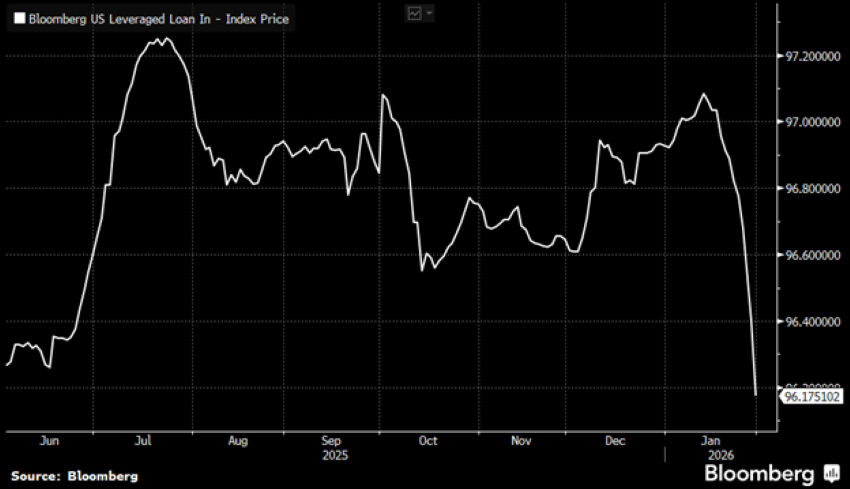
The U.S. loan market rang in the new year with a strong start, gaining 0.46% through Jan. 19 and new issuance surged to its highest level in six months.1 Momentum, however, faded quickly as January progressed. Bids weakened sharply, and the loan market ultimately ended the month in negative territory, marking its first monthly loss since April 2025.2 The abrupt reversal was driven primarily by mounting concerns surrounding the software sector, which weighed heavily on overall market sentiment.
The software sector is the largest component of the leveraged loan index, representing roughly 12%.3 Due to its size, performance within the sector has a significant impact on the broader index. In January, software‑related loans declined nearly 3%, marking their weakest performance since 2022.4 Taking a closer look, while 47% of software names in the leveraged loan index were trading above par at the beginning of January, that figure has since dropped to below 10%.5 High loan-to-value, leveraged buyout software names were among the hardest hit, trading down approximately seven to 10 points.6
Historically, software companies have been viewed as relatively stable, while being highly leveraged with debt. Investor sentiment has shifted, however, as advances in artificial intelligence (AI) have raised concerns that many existing software products and services could become obsolete. AI is increasingly viewed as a potential disruptor to software business models. Loan prices have been feeling this pressure, with many loans trading at their lowest levels in months by the end of January.7 The bid has evaporated for loans with software exposure amid growing questions around growth prospects. Despite these headwinds, not all developments in the loan market have been negative. An estimated $17.2 billion of loan repayments unrelated to new issues came due in January—the highest monthly total since July 2019—providing investors a continued influx of cash.8
Key Takeaway
The loan market started the year on solid footing but quickly lost momentum. Early gains gave way to fading confidence and declining prices, leaving the market in negative territory by the end of January. The downturn was largely driven by growing concerns regarding the software sector, a sizeable component of the leveraged loan index that saw sharp declines as investors questioned how AI could disrupt traditional software businesses. This pressure also affected the high-yield corporate bond market. While high yield holds materially less exposure to software issuers than their loan counterparts, it still exhibited some weakness. It remains unclear how many of the companies currently under pressure are at risk of being undermined. Nonetheless, this is a trend worth monitoring, particularly given the continued need for investors to redeploy cash.
Sources:
1-4PitchBook Data, Inc. – January Wrap: Hot leveraged loan primary market meets cold secondary amid software slump; 2/2/26
5,6JPMorgan
7Bloomberg
8Credit Sights; 1/30/26
This material is for informational use only. The views expressed are those of the author, and do not necessarily reflect the views of Penn Mutual Asset Management. This material is not intended to be relied upon as a forecast, research or investment advice, and it is not a recommendation, offer or solicitation to buy or sell any securities or to adopt any investment strategy.
Opinions and statements of financial market trends that are based on current market conditions constitute judgment of the author and are subject to change without notice. The information and opinions contained in this material are derived from sources deemed to be reliable but should not be assumed to be accurate or complete. Statements that reflect projections or expectations of future financial or economic performance of the markets may be considered forward-looking statements. Actual results may differ significantly. Any forecasts contained in this material are based on various estimates and assumptions, and there can be no assurance that such estimates or assumptions will prove accurate.
Investing involves risk, including possible loss of principal. Past performance is no guarantee of future results. All information referenced in preparation of this material has been obtained from sources believed to be reliable, but accuracy and completeness are not guaranteed. There is no representation or warranty as to the accuracy of the information and Penn Mutual Asset Management shall have no liability for decisions based upon such information.
High-Yield bonds are subject to greater fluctuations in value and risk of loss of income and principal. Investing in higher yielding, lower rated corporate bonds have a greater risk of price fluctuations and loss of principal and income than U.S. Treasury bonds and bills. Government securities offer a higher degree of safety and are guaranteed as to the timely payment of principal and interest if held to maturity.
All trademarks are the property of their respective owners. This material may not be reproduced in whole or in part in any form, or referred to in any other publication, without express written permission.