
When Fear Leads Reality: Inside 2026’s Volatility Surge
March 26, 2026
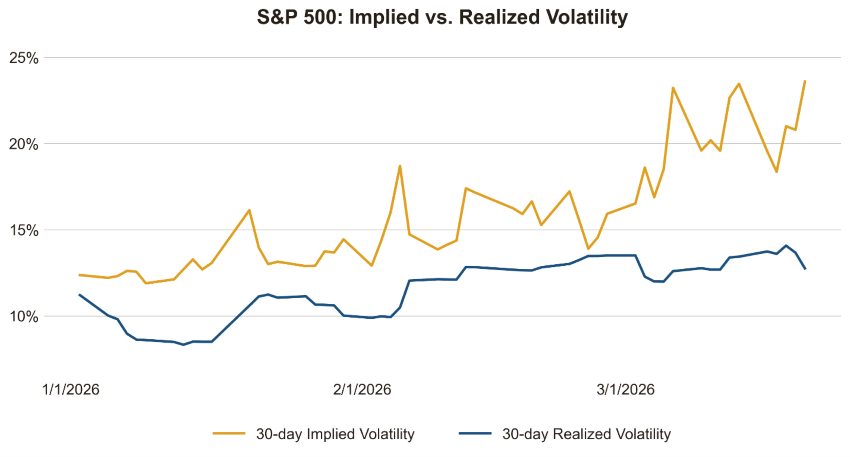
Equity implied volatility has diverged sharply from realized volatility in early 2026. The S&P 500 Index’s 30-day implied volatility has climbed above 23%, nearly double the level observed at the start of the year, even as the index’s 30-day realized volatility has remained below 14%.1,2 As seen in today’s Chart of the Week, the gap between these two measures has widened to one of its largest levels in recent years. This spread, known as the volatility risk premium, shows the excess price investors are paying for options protection above the volatility actually being experienced. Its current magnitude suggests the market is pricing in much more turbulence than has materialized to date.
Several factors have driven implied volatility higher. The escalation of conflict in the Middle East in late February sent oil prices surging toward $120 per barrel before settling near $92, reviving stagflation concerns across global markets.3 Inflation has remained above the Federal Reserve’s (Fed) target, with core Personal Consumption Expenditures (PCE) at 3.1% and core Consumer Price Index (CPI) at 2.5%.4,5 The Fed’s March decision to hold the federal funds rate at 3.50–3.75%, while signaling limited scope for rate cuts in 2026, reinforced the view that monetary policy will not provide near-term relief.6 Meanwhile, the February employment report showed a loss of 92,000 jobs, introducing downside growth risks alongside persistent price pressures.7 The combination of a supply-driven energy shock, above-target inflation and a cautious central bank has fundamentally shifted market sentiment from the episodic volatility spikes of 2024 and 2025 toward a more persistently elevated baseline.
Despite these headwinds, daily price movements of the S&P 500 Index have remained relatively contained. The index is only modestly below its pre-shock levels, which helps explain why realized volatility has remained muted.8 The divergence does not signal a lack of risk. Instead, it shows a market pre-positioning for potential deterioration. Institutional hedging activity has intensified, with demand for put options and volatility-linked instruments driving implied rates higher.9 This repricing extends beyond U.S. large-cap equities: the Nasdaq-100 Volatility Index has reached the upper-20s, the Russell 2000 Volatility Index has exceeded 30 and EURO STOXX 50 Volatility has climbed above 25.10,11,12 The breadth of the move across regions and market capitalizations underscores that this is a global phenomenon, not an isolated U.S. equity dynamic.
Key Takeaway
The unusually wide gap between implied and realized volatility suggests the market is embedding a significant degree of uncertainty into option prices. Whether this premium normalizes through declining implied volatility or rising realized volatility will depend on the trajectory of geopolitical and inflationary risks. In either scenario, the current environment warrants a disciplined approach to risk management, as the sustained elevation in implied volatility marks a departure from the rapid spike-and-reversion pattern observed over the prior year.
Sources:
1,2,8-12Bloomberg
3International Energy Agency – Oil Market Report; 3/12/26
4U.S. Bureau of Economic Analysis – PCE Price Index; 3/13/26
5U.S. Bureau of Labor Statistics – Consumer Price Index; 3/11/26
6Board of Governors of the Federal Reserve System – FOMC Statement; 3/18/26
7U.S. Bureau of Labor Statistics – The Employment Situation; 3/6/26
This material is for informational use only. The views expressed are those of the author, and do not necessarily reflect the views of Penn Mutual Asset Management. This material is not intended to be relied upon as a forecast, research or investment advice, and it is not a recommendation, offer or solicitation to buy or sell any securities or to adopt any investment strategy.
Opinions and statements of financial market trends that are based on current market conditions constitute judgment of the author and are subject to change without notice. The information and opinions contained in this material are derived from sources deemed to be reliable but should not be assumed to be accurate or complete. Statements that reflect projections or expectations of future financial or economic performance of the markets may be considered forward-looking statements. Actual results may differ significantly. Any forecasts contained in this material are based on various estimates and assumptions, and there can be no assurance that such estimates or assumptions will prove accurate.
Investing involves risk, including possible loss of principal. Past performance is no guarantee of future results. All information referenced in preparation of this material has been obtained from sources believed to be reliable, but accuracy and completeness are not guaranteed. There is no representation or warranty as to the accuracy of the information and Penn Mutual Asset Management shall have no liability for decisions based upon such information.
High-Yield bonds are subject to greater fluctuations in value and risk of loss of income and principal. Investing in higher yielding, lower rated corporate bonds have a greater risk of price fluctuations and loss of principal and income than U.S. Treasury bonds and bills. Government securities offer a higher degree of safety and are guaranteed as to the timely payment of principal and interest if held to maturity.
All trademarks are the property of their respective owners. This material may not be reproduced in whole or in part in any form, or referred to in any other publication, without express written permission.