
Valuations for AI-Native Companies Continue to Soar
April 16, 2026
It’s hard to imagine a time when we weren’t talking about artificial intelligence (AI) on a daily basis. The technology has become one of the most dominant market narratives in recent memory, and it appears that it will continue. For context, ChatGPT, OpenAI’s flagship consumer product, was released in November of 2022, less than four years ago. The advancement in the technology over just a few short years has been astounding, as has its adoption by consumers and enterprises alike.
Given the demand for many of these products, the growth in AI-native businesses over the past few years has been exponential. Nearly every day brings headlines about a new large language model breakthrough, or a new use case for Claude (Anthropic’s AI product) that will seemingly make one or more publicly traded companies obsolete almost overnight. While such claims are often overstated, the sheer growth and scale of these AI-native businesses is worth watching.
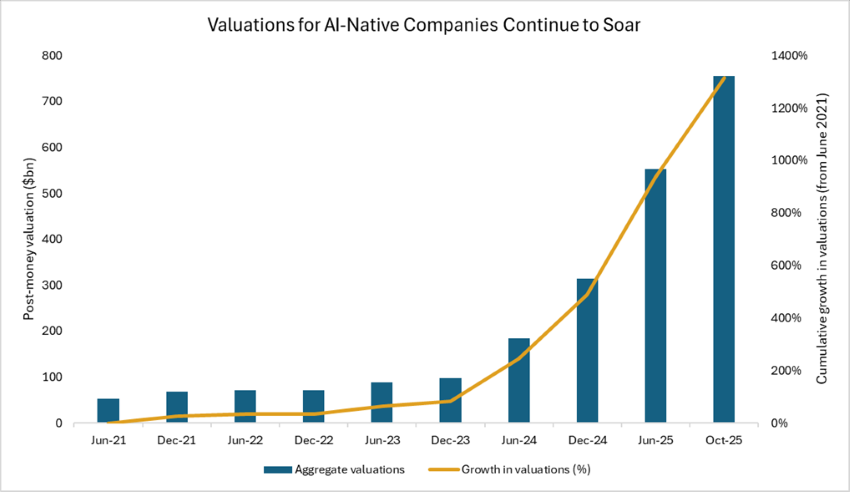
As highlighted in today’s Chart of the Week, valuations of these pure-play AI companies are rapidly rising. Are these valuations justified? It was reported last week that Anthropic crossed $30 billion in annual recurring revenue (ARR),1 which was roughly 30x growth in 15 months, with ARR increasing from $9 billion to $30 billion in only four months.2 This top-line growth, along with the adoption seen by Anthropic and many other companies, will ultimately result in a valuation uplift. According to Preqin, valuations for the 10 major AI start-ups in their sample set more than doubled between December 2024 and October 2025, a 140% increase.
While the growth in aggregate valuations is already striking, the figures in the chart do not reflect the most recent funding rounds for Anthropic and OpenAI, which were valued at $380 billion and $730 billion,3,4 respectively. If these were included in the chart, the aggregate growth would be much more significant. AI-native businesses are creating value for consumers and enterprises, but how rich can these companies be valued? This debate is front and center for investors today, though those who participated in the most recent funding rounds for Anthropic and OpenAI clearly believe there will be attractive forward returns from here.
Key Takeaway
AI is one of the most significant market themes of the last decade, and many new companies are being formed around the technology. There is clear demand for many of the products these AI-native companies are developing, and as a result of this traction and growth, the valuations of these businesses have grown in lockstep. These companies have increasingly become embedded in daily life, impacting how people interact and work. Will sustained interest and adoption of these products continue, and as a result, are these companies appropriately valued? That is a debate many investors, both public and private, are having daily.
It will be interesting to see how AI continues to permeate the public and private markets, as well as how many enterprises, small and large, develop products surrounding the technology. For now, it appears the growth in valuations is justified given the demand, but just how much is up for debate.
Sources:
1Bloomberg – Anthropic Tops $30 Billion Run Rate, Seals Broadcom Deal; 4/7/26
2The AI Corner – Anthropic Just Passed OpenAI in Revenue. Spending 4x Less; 4/7/26
3Barron’s – Anthropic Is Now Worth $380 Billion. Software’s Pain Is AI’s Gain; 2/12/26
4Yahoo! Finance – OpenAI valuation hits $730B as it raises $100B in latest funding round; 2/27/26
This material is for informational use only. The views expressed are those of the author, and do not necessarily reflect the views of Penn Mutual Asset Management. This material is not intended to be relied upon as a forecast, research or investment advice, and it is not a recommendation, offer or solicitation to buy or sell any securities or to adopt any investment strategy.
Opinions and statements of financial market trends that are based on current market conditions constitute judgment of the author and are subject to change without notice. The information and opinions contained in this material are derived from sources deemed to be reliable but should not be assumed to be accurate or complete. Statements that reflect projections or expectations of future financial or economic performance of the markets may be considered forward-looking statements. Actual results may differ significantly. Any forecasts contained in this material are based on various estimates and assumptions, and there can be no assurance that such estimates or assumptions will prove accurate.
Investing involves risk, including possible loss of principal. Past performance is no guarantee of future results. All information referenced in preparation of this material has been obtained from sources believed to be reliable, but accuracy and completeness are not guaranteed. There is no representation or warranty as to the accuracy of the information and Penn Mutual Asset Management shall have no liability for decisions based upon such information.
High-Yield bonds are subject to greater fluctuations in value and risk of loss of income and principal. Investing in higher yielding, lower rated corporate bonds have a greater risk of price fluctuations and loss of principal and income than U.S. Treasury bonds and bills. Government securities offer a higher degree of safety and are guaranteed as to the timely payment of principal and interest if held to maturity.
All trademarks are the property of their respective owners. This material may not be reproduced in whole or in part in any form, or referred to in any other publication, without express written permission.