
Diesel Squeeze: Rising Prices as Distillate Exports Surge and Inventories Tighten
May 14, 2026
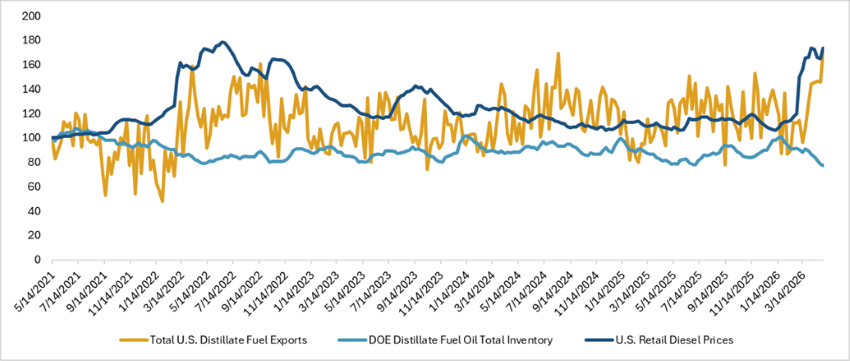
Concerns have emerged around potential disruptions to crude and product flows through the Strait of Hormuz, which averaged 20 million barrels per day in 2025—about 25% of global seaborne oil—since tensions with Iran began to escalate.1 As seen in today’s Chart of the Week, as the conflict with Iran has persisted, the U.S. has been exporting distillates at the highest rate in at least five years, while inventories have simultaneously reached lows.2 Given these market dynamics, diesel prices at the pump have been climbing, most recently now approaching levels last seen in June 2022 during the peak of the Russia-Ukraine war.3
While the average consumer is not buying diesel at the pump, it is often considered “the lifeblood of the economy,” and this spike in diesel prices will place pressure on supply chains and trickle down to the consumer.4 Auto transport costs are approximately 25% fuel-related,5 and diesel prices are up nearly 60% since the start of the year.6 This uptick in transport costs affects many products that need to move across the U.S., potentially putting upward pressure on items such as manufacturing, building products, groceries and more. Additionally, even if prices ease in the near-term, higher transport prices could persist, as freight companies sign long-term diesel supply contracts that can remain in their cost structure for months.
Key Takeaway
The U.S. has become a major distillate exporter amid ongoing Middle East tensions, driving inventory levels down and raising diesel prices to recent highs. If this market dynamic continues, consumers may feel upward pricing pressures across the economy due to higher freight and transport costs for moving crucial goods and commodities.
Sources:
1IEA – Strait of Hormuz Factsheet; February 2026
2,3,6Bloomberg
4Bloomberg – US Exports of Oil Products Reach Record on Diesel Demand; 5/5/26
5Bloomberg – Super Dispatch: Diesel price volatility strains auto transport margins; 5/5/26
This material is for informational use only. The views expressed are those of the author, and do not necessarily reflect the views of Penn Mutual Asset Management. This material is not intended to be relied upon as a forecast, research or investment advice, and it is not a recommendation, offer or solicitation to buy or sell any securities or to adopt any investment strategy.
Opinions and statements of financial market trends that are based on current market conditions constitute judgment of the author and are subject to change without notice. The information and opinions contained in this material are derived from sources deemed to be reliable but should not be assumed to be accurate or complete. Statements that reflect projections or expectations of future financial or economic performance of the markets may be considered forward-looking statements. Actual results may differ significantly. Any forecasts contained in this material are based on various estimates and assumptions, and there can be no assurance that such estimates or assumptions will prove accurate.
Investing involves risk, including possible loss of principal. Past performance is no guarantee of future results. All information referenced in preparation of this material has been obtained from sources believed to be reliable, but accuracy and completeness are not guaranteed. There is no representation or warranty as to the accuracy of the information and Penn Mutual Asset Management shall have no liability for decisions based upon such information.
High-Yield bonds are subject to greater fluctuations in value and risk of loss of income and principal. Investing in higher yielding, lower rated corporate bonds have a greater risk of price fluctuations and loss of principal and income than U.S. Treasury bonds and bills. Government securities offer a higher degree of safety and are guaranteed as to the timely payment of principal and interest if held to maturity.
All trademarks are the property of their respective owners. This material may not be reproduced in whole or in part in any form, or referred to in any other publication, without express written permission.