
The PIK Picture: Tracking Non-Cash Income in BDC Portfolios
June 18, 2026
Private credit has become a hot topic of conversation over the past several months. More specifically, business development companies (BDCs) are a consistent subject of headlines and market commentary. BDCs are closed-end funds regulated under the Investment Company Act of 1940. Portfolios consist primarily of senior secured loans to middle-market companies. While definitions may vary, these companies typically generate yearly earnings before interest, taxes, depreciation and amortization (EBITDA) of $10-100 million. The BDC sector has grown swiftly from just over $100 billion in assets under management (AUM) in 2020 to $475 billion in early 2025.1
These fund structures and the broader private credit landscape have come under heavy scrutiny, beginning with the high-profile blowups of First Brands and Tricolor in late 2025 and evolving to include fears that artificial intelligence (AI) may render certain private-credit-funded software companies obsolete. This sentiment is reflected in prices: the S&P BDC Index, which tracks over 40 publicly traded BDCs, is down over 20% since June 2025.2 Investors in non-traded, private BDCs, on the other hand, have displayed their concerns through elevated redemption requests.3
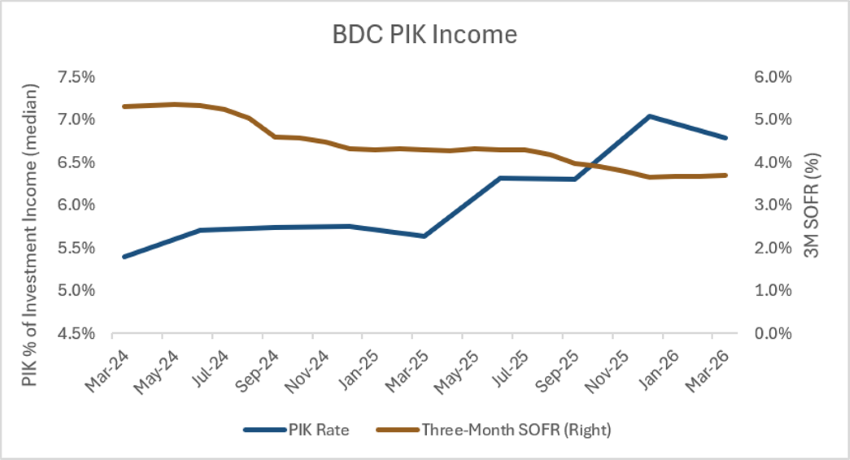
While AI-driven speculation may be one driver of performance, investors are also likely to be concerned about deteriorating portfolio fundamentals. As presented in today’s Chart of the Week, a growing share of investment income at 32 of the largest public and non-traded BDCs is coming in the form of payment-in-kind (PIK) interest. PIK is non-cash interest that accrues to the balance of a debt security, increasing the principal outstanding when utilized. While PIK structures are not inherently negative or a sign of an upcoming default, they are often implemented through credit amendments to give portfolio companies relief on their debt service at times when cash flow generation and performance are strained. Though this trend could potentially be an indicator of future pain in the asset class, it may also be evidence that flexibility, one of the main appeals of private credit for borrowers, is working as intended. Private credit loans are predominantly floating-rate, pricing off the three-month Secured Overnight Financing Rate (SOFR); this base rate has remained above 3.5% since late 2022.4 For companies facing sustained elevated borrowing costs, lender flexibility and PIK constructs may allow them to weather the storm. Additionally, the Kroll Bond Rating Agency Direct Lending Index trailing 12-month par-weighted default rate is currently 1.5%, compared to a leveraged loan default rate of 1.28%; while current levels of non-cash interest may signal weakness, private credit does not appear to be significantly underperforming its public counterpart.5
Key Takeaway
For BDCs, PIK interest as a percentage of investment income is elevated, and these structures continue to attract negative press. However, with relatively benign private credit default rates, it remains to be seen whether risks from software disintermediation will lead to broader portfolio stress. An important question to consider is whether elevated PIK interest in BDC and private credit portfolios will be a leading indicator of underperformance or a future case study portraying one of the merits of the asset class.
Sources:
1Apollo – The ABCs of BDCs; August 2025
2,4Bloomberg
3Fitch Ratings – Perpetually Non-Traded US BDCs See Higher Redemptions, Slower Fundraising; 2/17/26
5J.P. Morgan – Default Monitor; 6/1/26
This material is for informational use only. The views expressed are those of the author, and do not necessarily reflect the views of Penn Mutual Asset Management. This material is not intended to be relied upon as a forecast, research or investment advice, and it is not a recommendation, offer or solicitation to buy or sell any securities or to adopt any investment strategy.
Opinions and statements of financial market trends that are based on current market conditions constitute judgment of the author and are subject to change without notice. The information and opinions contained in this material are derived from sources deemed to be reliable but should not be assumed to be accurate or complete. Statements that reflect projections or expectations of future financial or economic performance of the markets may be considered forward-looking statements. Actual results may differ significantly. Any forecasts contained in this material are based on various estimates and assumptions, and there can be no assurance that such estimates or assumptions will prove accurate.
Investing involves risk, including possible loss of principal. Past performance is no guarantee of future results. All information referenced in preparation of this material has been obtained from sources believed to be reliable, but accuracy and completeness are not guaranteed. There is no representation or warranty as to the accuracy of the information and Penn Mutual Asset Management shall have no liability for decisions based upon such information.
High-Yield bonds are subject to greater fluctuations in value and risk of loss of income and principal. Investing in higher yielding, lower rated corporate bonds have a greater risk of price fluctuations and loss of principal and income than U.S. Treasury bonds and bills. Government securities offer a higher degree of safety and are guaranteed as to the timely payment of principal and interest if held to maturity.
All trademarks are the property of their respective owners. This material may not be reproduced in whole or in part in any form, or referred to in any other publication, without express written permission.