
The Frequent Issuer Discount
July 16, 2026
The world's largest technology companies are dramatically increasing their capital expenditures (capex) on data centers, servers, networking equipment, power infrastructure and real estate. These hyperscalers are racing to spend hundreds of billions of dollars to build the digital infrastructure needed to support cloud computing and artificial intelligence (AI).
This level of spending is historic, and it is projected that spending by AI platform companies could reach $1 trillion in 2027.1 Hyperscalers are shifting from predominantly cash-funded operations to more aggressive, leverage-driven models. This transition is sparking a massive corporate debt and capex cycle, with corporate bond supply on pace to reach a record high this year.2
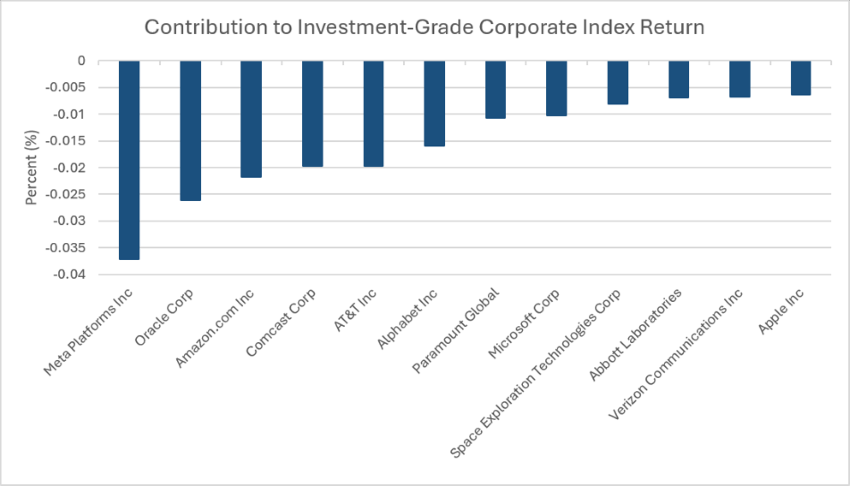
Interestingly, the bonds recently issued by these hyperscalers have not performed well. As shown in today’s Chart of the Week, hyperscalers including Meta, Oracle and Amazon have been among the largest negative contributors to returns within the Investment-Grade Corporate Index year to date. Historically, these large technology companies were consummate bond issuers, with substantial cash reserves, generating billions in free cash flow and requiring relatively little capital to support growth. While free cash flow has declined as investment spending has accelerated, these companies remain exceptionally strong from a default perspective. Nevertheless, their bonds have continued to underperform, largely due to increased bond issuance that has weakened technicals.
A steady supply of new debt can pressure existing bonds by eroding scarcity value. Buyers do not need to chase today’s bond when a newer, more liquid issue is likely to arrive soon with a concession. Existing bonds can become less attractive relative to a newly issued bond and may reprice lower even if the company's earnings and credit ratings remain unchanged. This phenomenon is known as the frequent issuer discount.
For shareholders, on the other hand, the potential rewards are greater. If these investments prove successful, hyperscalers may emerge with greater scale, stronger earnings power and a wider competitive moat. The stock would likely reflect that improvement. However, bondholders do not participate in the same degree of upside, as their returns are largely fixed regardless of how successful the investment becomes.
Key Takeaway
A larger addressable market often encourages more aggressive spending, greater capex and increased debt issuance. Ironically, companies with the strongest growth prospects may create the least favorable conditions for existing bondholders. The key risk for credit investors is not that hyperscalers will be unable to repay their debt, but rather that the enormous AI investment opportunities encourage heavy spending and repeated issuance. As we are seeing today, repeated issuance can create a less favorable setup for bondholders.
Sources:
1S&P Global – AI Investment Accelerates Across U.S. Tech While Cost Pressures Intensify Broadly; Ratings Impact Mostly Positive; 5/7/26
2Barclays
This material is for informational use only. The views expressed are those of the author, and do not necessarily reflect the views of Penn Mutual Asset Management. This material is not intended to be relied upon as a forecast, research or investment advice, and it is not a recommendation, offer or solicitation to buy or sell any securities or to adopt any investment strategy.
Opinions and statements of financial market trends that are based on current market conditions constitute judgment of the author and are subject to change without notice. The information and opinions contained in this material are derived from sources deemed to be reliable but should not be assumed to be accurate or complete. Statements that reflect projections or expectations of future financial or economic performance of the markets may be considered forward-looking statements. Actual results may differ significantly. Any forecasts contained in this material are based on various estimates and assumptions, and there can be no assurance that such estimates or assumptions will prove accurate.
Investing involves risk, including possible loss of principal. Past performance is no guarantee of future results. All information referenced in preparation of this material has been obtained from sources believed to be reliable, but accuracy and completeness are not guaranteed. There is no representation or warranty as to the accuracy of the information and Penn Mutual Asset Management shall have no liability for decisions based upon such information.
High-Yield bonds are subject to greater fluctuations in value and risk of loss of income and principal. Investing in higher yielding, lower rated corporate bonds have a greater risk of price fluctuations and loss of principal and income than U.S. Treasury bonds and bills. Government securities offer a higher degree of safety and are guaranteed as to the timely payment of principal and interest if held to maturity.
All trademarks are the property of their respective owners. This material may not be reproduced in whole or in part in any form, or referred to in any other publication, without express written permission.