
Private Equity Spending in Defense and Aerospace Resurgent
July 23, 2026
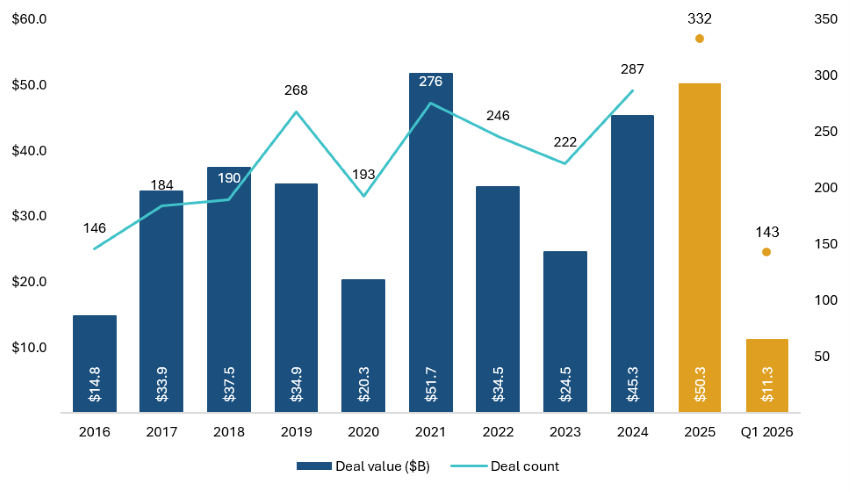
Private equity's (PE) appetite for defense and aerospace assets has gone from niche to one of the hottest areas of capital deployment. Global PE deal value in the sector approached record levels in 2025, reaching an estimated $50.3 billion—just shy of 2021’s record level of $51.7 billion—while deal count hit record levels in 2025, with an estimated 332 transactions versus the previous high of 287 set the year before.1 This strong momentum has continued into 2026, with first-quarter deal value reaching an estimated $11.3 billion versus $7.7 billion over the same period in 2025.2,3 Impressively, defense-specific transactions increased nearly 400% year over year.4 After a multi-year lull in 2022 and 2023, sponsors are once again competing actively for assets in a sector that many previously viewed as too controversial, too cyclical or both, to pursue aggressively.
The most obvious driver is government spending: defense budgets are expanding to historically elevated levels, and PE firms are positioning themselves ahead of the spending. The U.S. 2026 Department of Defense (DoD) budget request was $961.6 billion, a 13% increase over the fiscal year 2025 budget and a nearly 65% increase over the budget a decade ago.5,6 At $1.5 trillion, a nearly 56% increase over 2026’s budget, the 2027 DoD budget request would exceed any DoD budget request ever submitted to Congress.7 European governments are moving in lockstep. The North Atlantic Treaty Organization (NATO) members agreed at the 2025 Hague Summit to lift defense spending toward 5% of gross domestic product (GDP) by 2035, nearly triple the old target, while Germany's constitutional amendment exempting defense spending from its balanced budget considerations has freed up hundreds of billions of euros in new procurement capacity.8,9 Further, the European Union's ReArm Europe Plan/Readiness 2030 initiative is aiming to mobilize roughly €800 billion for defense investment.10 For sponsors, this represents one of the clearest examples of a visible, government-supported demand backdrop available in private markets.
A second driver is the blurring line between commercial and military technology. Dual-use companies—those selling software, sensors, space systems or advanced manufacturing capabilities that serve both civilian and defense customers—have become an attractive entry point for PE firms that might otherwise be reluctant to invest explicitly in offensive military hardware. This convergence has widened the investable universe considerably, pulling in firms with no historical defense pedigree and giving limited partners (LPs) with environmental, social and governance (ESG) mandates a more palatable way to gain exposure to the theme without directly backing munitions or weapons platforms.
Structurally, the sector has also become easier to underwrite. Much of the current deal flow is concentrated in fragmented, tier-two and tier-three supply chains—component makers, maintenance and repair providers, electronics specialists—rather than the tier-one defense contractors that typically dominate the headlines. These are exactly the types of businesses PE firms are well positioned to scale: consolidation-friendly, ripe for operational improvement and insulated from single-customer concentration risk. At the same time, buyer and seller price expectations across the PE landscape, which diverged significantly following the pandemic, have converged, making deals easier to close. Commercial aerospace, for its own part, has added its own tailwind to the sector, as aircraft delivery delays at Boeing and Airbus have forced airlines to extend the service life of aging fleets, driving deal activity in maintenance, repair and overhaul businesses alongside the defense buildout.
Key Takeaway
How long this investment opportunity persists is the real question for allocators. PE investors are underwriting a multi-year runway of government spending commitments that, in theory, offer unusual cash-flow visibility. However, that same government dependency is also the sector's biggest risk: procurement cycles may be politically driven, budget priorities can shift with elections or fiscal pressure and the current wave of capital could eventually run into the same crowding and multiple-expansion problems that have emerged in other favored PE sectors. For now, though, the combination of record defense budgets, dual-use technology convergence and a fragmented, operationally improvable group of companies has made defense and aerospace one of the more compelling growth stories in PE.
Sources:
1,2,4PitchBook Data, Inc. – Q1 2026 Aerospace & Defense Report; 5/13/26
3PitchBook Data, Inc. – Q1 2025 Aerospace & Defense Report; 5/21/25
5Department of Defense – Defense Budget Overview, United States Department of Defense, Fiscal Year 2026 Budget Request; July 2025
6Department of Defense – DoD Releases Fiscal Year 2016 Budget Proposal; 2/2/15
7Center for Strategic & International Studies – Unpacking the $1.5 Trillion FY 2027 Defense Budget Topline; 4/10/26
8CNBC – NATO allies agree to higher 5% defense spending target; 6/25/25
9NOERR – German Bundestag approves exemption from the debt brake for defense spending and special funds for investments in infrastructure and climate protection; 3/21/25
10European Parliament – ReArm Europe Plan/Readiness 2030; April 2025
This material is for informational use only. The views expressed are those of the author, and do not necessarily reflect the views of Penn Mutual Asset Management. This material is not intended to be relied upon as a forecast, research or investment advice, and it is not a recommendation, offer or solicitation to buy or sell any securities or to adopt any investment strategy.
Opinions and statements of financial market trends that are based on current market conditions constitute judgment of the author and are subject to change without notice. The information and opinions contained in this material are derived from sources deemed to be reliable but should not be assumed to be accurate or complete. Statements that reflect projections or expectations of future financial or economic performance of the markets may be considered forward-looking statements. Actual results may differ significantly. Any forecasts contained in this material are based on various estimates and assumptions, and there can be no assurance that such estimates or assumptions will prove accurate.
Investing involves risk, including possible loss of principal. Past performance is no guarantee of future results. All information referenced in preparation of this material has been obtained from sources believed to be reliable, but accuracy and completeness are not guaranteed. There is no representation or warranty as to the accuracy of the information and Penn Mutual Asset Management shall have no liability for decisions based upon such information.
High-Yield bonds are subject to greater fluctuations in value and risk of loss of income and principal. Investing in higher yielding, lower rated corporate bonds have a greater risk of price fluctuations and loss of principal and income than U.S. Treasury bonds and bills. Government securities offer a higher degree of safety and are guaranteed as to the timely payment of principal and interest if held to maturity.
All trademarks are the property of their respective owners. This material may not be reproduced in whole or in part in any form, or referred to in any other publication, without express written permission.