
AI Infrastructure Bonds: A Full Picture of Spreads
August 6, 2026
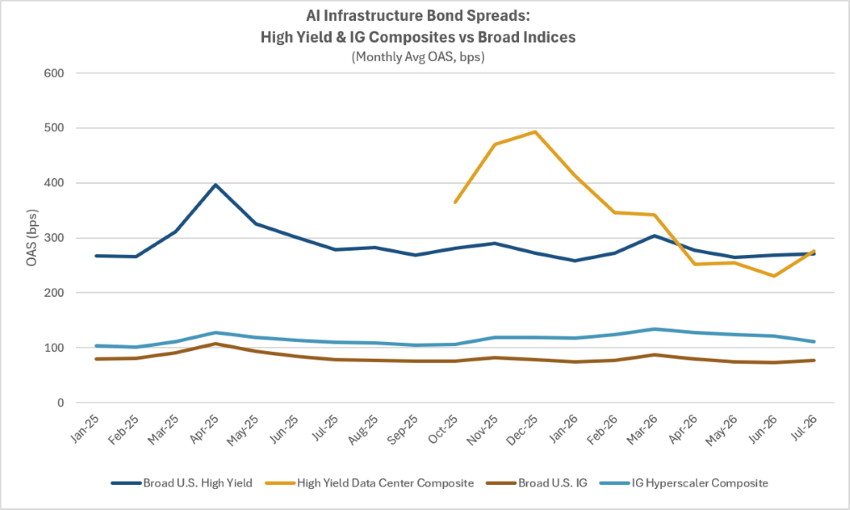
The artificial intelligence (AI) buildout has triggered a massive wave of corporate bond issuance and other debt financing. Since 2024, more than $450 billion in AI-linked debt has been financed across credit markets.1 This supply falls into two categories: investment-grade (IG) bonds issued by the large hyperscalers to fund their own capital expenditures (capex), and high-yield bonds issued by smaller data center operators to build capacity that is often leased to hyperscaler tenants. Today’s Chart of the Week tracks how credit markets have priced risk across both groups and how quickly that picture has changed over time.
The High Yield Data Center Composite includes Core Scientific, TeraWulf, Applied Digital and Meridian Arc. Data begins in October 2025, reflecting the earliest bond issuance in the group. The IG Hyperscaler Composite includes Microsoft, Amazon, Google, Meta and Oracle. Both are plotted against their respective broad indices from January 2025 through July 2026. The gap between these composites and the broader market, as well as how that gap has changed over time, is the story.
At their widest in December 2025, high-yield data center bonds traded approximately 220 basis points (bps) wider than the broad high-yield index.2 Investors were cautious about construction risk, unproven cash flows and heavy reliance on a small number of tenants. That premium compressed sharply through the first half of 2026. Investors grew comfortable with the so-called powered shell structure.3 In this structure, data center operators issue bonds supported by cash flows from long-term leases with hyperscaler tenants. As a result, the tenant’s creditworthiness and the durability of its lease payments become key underwriting considerations. The premium that once compensated investors for the added risk has largely disappeared. As of late July, however, high-yield data center spreads have started to widen again, reflecting growing caution about whether AI demand will hold up at the pace originally anticipated.
The IG picture tells a different story. Hyperscaler bonds have consistently traded wider than the broad IG index, with the gap increasing from approximately 20 to 25 bps in early 2025 to about 35 bps by July 2026.4 That gap has widened over much of the period, reaching nearly 50 bps in the first half of 2026, before narrowing somewhat in recent months.5 A steady stream of new issuance from these companies has pressured existing bonds. Despite strong underlying credit quality, aggressive capex has pushed leverage higher and given buyers little reason to chase today’s bond when another deal is likely coming soon.
Since June 2026, high-yield data center spreads have widened as investors have become more cautious on execution-intensive AI infrastructure investments, while IG hyperscaler spreads have tightened modestly due to their larger scale and stronger access to capital. Risks that seemed manageable earlier in the year have come back into focus, including whether AI revenue growth will be enough to support long-term lease obligations, construction timelines, chip refresh cycles and concentrated exposure to a handful of tenants. AI-linked bonds still represent only about 2% to 3% of public IG and high-yield benchmarks.6 Some have compared the current buildout with the telecom expansion of the late 1990s, when telecom’s index weight increased from 1% in 1995 to 20.3% in 1999 ahead of the dot-com bust.7 This serves as a reminder that nascent sectors can scale quickly and that front-loaded debt financing against unproven revenue streams carries real risk.
Key Takeaway
Credit markets appear to be at a turning point in how they price AI infrastructure risk. High-yield data center spreads have compressed so much that investors are no longer being paid a meaningful premium over the broad market. At the same time, IG hyperscaler bonds have underperformed due to relentless supply. The speed at which sentiment has shifted in both markets is perhaps the most telling sign of how unsettled AI credit risk remains.
Special thanks to PMAM co-op Sanaya Sinharoy for contributing today's Chart of the Week. We appreciate Sanaya's hard work, curiosity and fresh perspective, and we're grateful for her contributions to the team this summer.
Sources:
1,3,6,7Bank of America Global Research; May 2026
2,4,5Bloomberg
This material is for informational use only. The views expressed are those of the author, and do not necessarily reflect the views of Penn Mutual Asset Management. This material is not intended to be relied upon as a forecast, research or investment advice, and it is not a recommendation, offer or solicitation to buy or sell any securities or to adopt any investment strategy.
Opinions and statements of financial market trends that are based on current market conditions constitute judgment of the author and are subject to change without notice. The information and opinions contained in this material are derived from sources deemed to be reliable but should not be assumed to be accurate or complete. Statements that reflect projections or expectations of future financial or economic performance of the markets may be considered forward-looking statements. Actual results may differ significantly. Any forecasts contained in this material are based on various estimates and assumptions, and there can be no assurance that such estimates or assumptions will prove accurate.
Investing involves risk, including possible loss of principal. Past performance is no guarantee of future results. All information referenced in preparation of this material has been obtained from sources believed to be reliable, but accuracy and completeness are not guaranteed. There is no representation or warranty as to the accuracy of the information and Penn Mutual Asset Management shall have no liability for decisions based upon such information.
High-Yield bonds are subject to greater fluctuations in value and risk of loss of income and principal. Investing in higher yielding, lower rated corporate bonds have a greater risk of price fluctuations and loss of principal and income than U.S. Treasury bonds and bills. Government securities offer a higher degree of safety and are guaranteed as to the timely payment of principal and interest if held to maturity.
All trademarks are the property of their respective owners. This material may not be reproduced in whole or in part in any form, or referred to in any other publication, without express written permission.