
Beyond Payrolls: Falling Labor Force Participation Signals a Softer Labor Market
August 13, 2026
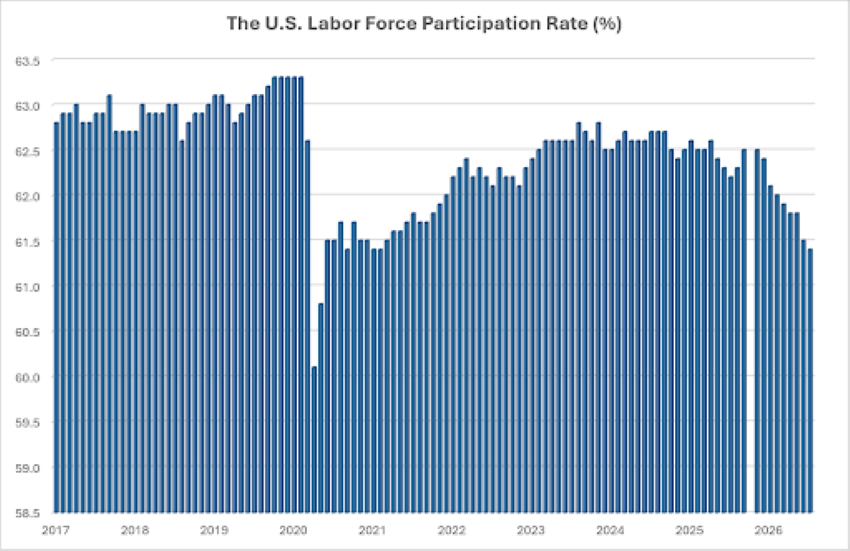
Last week, the Bureau of Labor Statistics (BLS) released July payroll data. The headline result was generally viewed as disappointing, with nonfarm payrolls declining by 23,000 in July, versus expectations for an 80,000 gain.1 The result was negatively affected by a 53,000 decline in government jobs, but even accounting for just the private sector, the 30,000 increase in private-sector jobs was underwhelming compared with historical periods.2 While much of the focus was on the payroll data, the labor force participation data continued to decline in July.
As today’s Chart of the Week shows, the U.S. labor force participation rate declined to 61.4% in July 2026, below the 61.5% registered in June and down 0.7 percentage points from January 2026.3,4 July also marked the lowest point since early 2021.5 The combination of modest private-sector hiring and a lower labor force participation rate could indicate a weakening U.S. employment picture.
Key Takeaway
Recent employment data may indicate early signs of softening in the labor market. This could ultimately affect consumer sectors if household income comes under pressure as both hiring and labor force participation slow.
Sources:
1Bloomberg
2CNBC – U.S. economy unexpectedly lost 23,000 jobs in July; 8/7/26
3U.S. Bureau of Labor Statistics – Employment Situation Summary Table A. Household data, seasonally adjusted; 8/7/26
4U.S. Bureau of Labor Statistics – Employment Situation Summary; 8/7/26
5U.S. Bureau of Labor Statistics – Civilian labor force participation rate; 8/7/26
This material is for informational use only. The views expressed are those of the author, and do not necessarily reflect the views of Penn Mutual Asset Management. This material is not intended to be relied upon as a forecast, research or investment advice, and it is not a recommendation, offer or solicitation to buy or sell any securities or to adopt any investment strategy.
Opinions and statements of financial market trends that are based on current market conditions constitute judgment of the author and are subject to change without notice. The information and opinions contained in this material are derived from sources deemed to be reliable but should not be assumed to be accurate or complete. Statements that reflect projections or expectations of future financial or economic performance of the markets may be considered forward-looking statements. Actual results may differ significantly. Any forecasts contained in this material are based on various estimates and assumptions, and there can be no assurance that such estimates or assumptions will prove accurate.
Investing involves risk, including possible loss of principal. Past performance is no guarantee of future results. All information referenced in preparation of this material has been obtained from sources believed to be reliable, but accuracy and completeness are not guaranteed. There is no representation or warranty as to the accuracy of the information and Penn Mutual Asset Management shall have no liability for decisions based upon such information.
High-Yield bonds are subject to greater fluctuations in value and risk of loss of income and principal. Investing in higher yielding, lower rated corporate bonds have a greater risk of price fluctuations and loss of principal and income than U.S. Treasury bonds and bills. Government securities offer a higher degree of safety and are guaranteed as to the timely payment of principal and interest if held to maturity.
All trademarks are the property of their respective owners. This material may not be reproduced in whole or in part in any form, or referred to in any other publication, without express written permission.