
The Long End Is Breaking Higher — Everywhere at Once
September 10, 2026
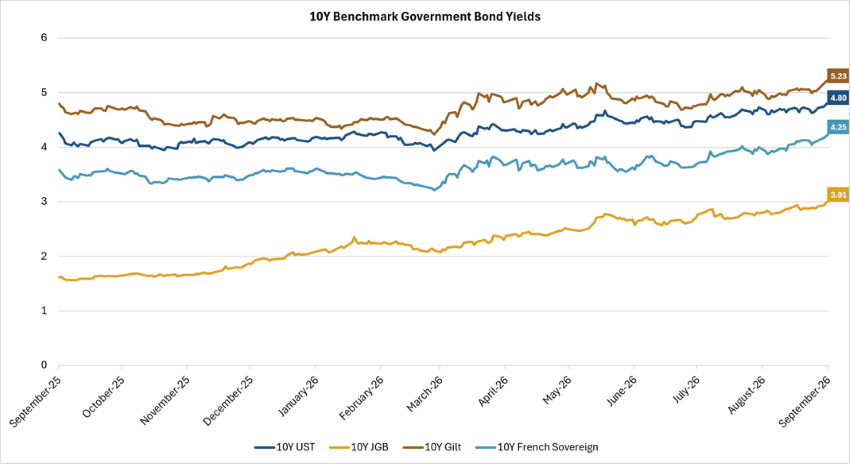
Global bond markets have been rattled not only by the large issuance of artificial intelligence (AI)-related debt, but also by volatility in the sovereign market. Four of the world's largest government borrowers saw long-end yields hit multi-decade highs within weeks of one another.
The U.S. 10-year Treasury is nearly 4.8%.1 UK 10-year gilts are around 5.23%, their highest level since the depths of the 2008 global financial crisis.2 French 10-year government bonds (OATs) have pushed above 4%, the highest levels since 2008.3 Japanese 10-year bonds have crossed 3% for the first time since 1996 — a historic move for a market that spent a generation anchored near zero.4
None of these moves is isolated. Governments are issuing more debt than markets want to absorb at prevailing prices, inflation refuses to fully settle and AI capital expenditure (capex) has emerged as a new competitor for capital. Sovereign borrowing hit a record in 2025 and is on pace to rise again even as demand for long-duration debt weakens,5 and this year's conflict in the Middle East has investors pricing in stickier inflation than they expected a few months ago. Still, each country is facing challenges of its own.
In the U.S., the selloff is not primarily a growth scare — the economy has proven more resilient than expected, and AI-driven capex is keeping growth expectations elevated. The complicating factor is the Federal Reserve (Fed): uncertainty around Chair Kevin Warsh’s inflation messaging has pressured the long end specifically, and total U.S. debt has just crossed $40 trillion.6 The Treasury has responded by doubling its long-bond buyback program to support liquidity in the 30-year sector,7 where yields have pushed above 5.3%, the highest since 2007,8 though its effect was short-lived.
Gilts are the starkest example of a market testing a government's fiscal promises in real time. The UK has bound itself to two rules: a pledge that the national debt will fall as a share of gross domestic product (GDP) by 2029/30, and a commitment to keep day-to-day government spending in balance rather than financed through borrowing. Unlike the U.S. story, this is less about a booming economy and more about doubt that the rules will be met. The 30-year gilt, near 5.80%, has not been this high since 1998.9 Chancellor of the Exchequer John Healey is due to present the government’s budget to Parliament in late October,10 when markets will see whether those promises will be kept.
France looks less like a rates story and more like a political one. Debt-to-GDP has climbed to roughly 118%, the deficit sits near 5% and both S&P and Fitch have downgraded French debt within the past 13 months.11,12 Notably, the spread between French and German 10-year yields has widened from roughly 71 basis points (bps) at the start of the year to around 87 bps currently.13 The National Assembly remains deadlocked over the national budget as a fragmented government struggles to produce a cohesive plan to pare back spending. With another contentious budget cycle ahead of the 2027 presidential election, France illustrates how fiscal pressures can become amplified when accompanied by political uncertainty.
Japan's move is the most structurally significant, even though its absolute yield level is the lowest of the four. A 10-year Japanese government bond (JGB) yield above 3% would have been unthinkable for most of the past three decades. The drivers are the Bank of Japan's gradual policy normalization, firming inflation and a public debt load north of 200% of GDP.14 The development carries global implications: as domestic yields rise, they are pulling Japanese investors — historically among the largest buyers of U.S. Treasuries — back home, creating a direct channel through which Japan's story feeds into the U.S. one.
Key Takeaway
Fiscal austerity and inflation controls will be key themes to watch. The governments that move credibly on both are the ones likely to see their borrowing costs come down.
Sources:
1-4,8,9,13Bloomberg
5OECD – Sovereign borrowing outlook: Global Debt Report 2026; 3/4/26
6The Wall Street Journal – U.S. National Debt Just Passed $40 Trillion: How We Got Here and Why; 8/19/26
7U.S. Department of the Treasury – Treasury Announces Increased Sizes of Nominal Long-End Liquidity Support Buybacks Beginning September 9; 8/19/26
10The Wall Street Journal – UK Pays Multi-Decade High Yields at Long-Term Debt Sale; 9/8/26
11European Commission – Economic forecast for France; 5/21/26
12The Economy – France Hit by Triple Credit Downgrade, Default Risk Looms Amid Fiscal Paralysis; 10/21/25
14The Wall Street Journal – Think Treasurys Are Having a Rough Summer? It’s Even Uglier Abroad; 8/27/26
This material is for informational use only. The views expressed are those of the author, and do not necessarily reflect the views of Penn Mutual Asset Management. This material is not intended to be relied upon as a forecast, research or investment advice, and it is not a recommendation, offer or solicitation to buy or sell any securities or to adopt any investment strategy.
Opinions and statements of financial market trends that are based on current market conditions constitute judgment of the author and are subject to change without notice. The information and opinions contained in this material are derived from sources deemed to be reliable but should not be assumed to be accurate or complete. Statements that reflect projections or expectations of future financial or economic performance of the markets may be considered forward-looking statements. Actual results may differ significantly. Any forecasts contained in this material are based on various estimates and assumptions, and there can be no assurance that such estimates or assumptions will prove accurate.
Investing involves risk, including possible loss of principal. Past performance is no guarantee of future results. All information referenced in preparation of this material has been obtained from sources believed to be reliable, but accuracy and completeness are not guaranteed. There is no representation or warranty as to the accuracy of the information and Penn Mutual Asset Management shall have no liability for decisions based upon such information.
High-Yield bonds are subject to greater fluctuations in value and risk of loss of income and principal. Investing in higher yielding, lower rated corporate bonds have a greater risk of price fluctuations and loss of principal and income than U.S. Treasury bonds and bills. Government securities offer a higher degree of safety and are guaranteed as to the timely payment of principal and interest if held to maturity.
All trademarks are the property of their respective owners. This material may not be reproduced in whole or in part in any form, or referred to in any other publication, without express written permission.