
Mid-Year Economic and Capital Markets Review & Outlook
July 28, 2026

Mid-Year Review
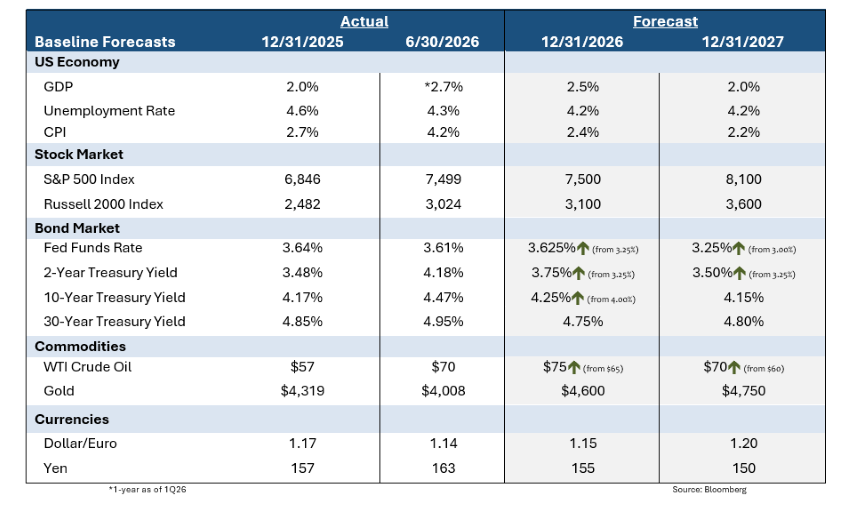
As we enter the second half of 2026, the PMAM team remains constructive on the economic and market outlook despite a more volatile first half than many anticipated entering the year. Economic growth has remained resilient, supported by healthy labor markets, strong corporate earnings, continued consumer spending and ongoing investment in artificial intelligence (AI). While geopolitical developments and fluctuations in energy prices created periods of uncertainty throughout the first half of the year, underlying economic fundamentals have generally remained supportive of risk assets and corporate credit markets.
AI investment continues to be a significant driver of economic activity and capital spending. Corporations remain focused on expanding technology infrastructure and enhancing productivity through AI-related initiatives, supporting both earnings growth and broader economic activity. At the same time, investor enthusiasm surrounding AI has become increasingly selective as markets focus on valuation, execution and the long-term return potential of elevated capital expenditures. We expect innovation and investment in AI to remain a key theme for both markets and the economy throughout the remainder of the year.
The Federal Reserve (Fed) remains in a challenging position as inflation continues to run above its long-term target. While easing energy prices and improving geopolitical conditions have helped moderate some inflationary pressures, the combination of resilient labor markets and steady economic growth has reduced the urgency for policy easing. Markets have adjusted to a higher-for-longer interest rate environment following Chair Kevin Warsh's initial policy meeting, and Treasury yields are likely to remain an important source of both opportunity and volatility moving forward.
Geopolitical developments remain an important variable. Progress toward reducing tensions in the Middle East and the reopening of key energy supply routes have provided welcome relief to inflation expectations and energy markets. However, geopolitical risks have not disappeared and will continue to influence both commodity prices and investor sentiment. As a result, periods of volatility should be expected as markets respond to evolving developments.
Outlook
The primary challenge for risk markets remains the combination of elevated interest rates and relatively rich valuations across portions of the equity market. Key risks include geopolitical instability, persistent inflation pressures, uncertainty surrounding future Fed policy, liquidity mismatches in private credit markets and AI-driven disruption across industries. While inflation has moderated from peak levels, progress toward the Fed's long-term objective remains uneven. Corporate credit spreads remain near historically tight levels,1 but all-in fixed-income yields continue to offer attractive opportunities relative to recent history. In our view, the current environment continues to favor active management, disciplined security selection and a focus on relative value opportunities across asset classes.
Although volatility is likely to persist, history suggests that periods of uncertainty can coexist with constructive market outcomes when economic fundamentals remain healthy. With growth remaining positive, unemployment relatively low and corporate fundamentals broadly supportive, we maintain a constructive outlook for the remainder of 2026. As always, remaining attentive to both monetary policy and Treasury market dynamics will be critical for investors navigating the balance between risk and opportunity in the months ahead.
For timely perspectives on the economy, markets and investing, be sure to subscribe to our publications below.
Sources:
1FRED — ICE BofA US Corporate Index Option-Adjusted Spread; 7/27/26
Index Definitions:
S&P 500 Index — An index of 500 stocks chosen for market size, liquidity and industry grouping, among other factors. The S&P 500 Index is designed to be a leading indicator of U.S. equities and is meant to reflect the risk/return characteristics of the large-cap universe.
Russell 2000 Index — An index measuring the performance of approximately 2,000 small-cap companies in the Russell 3000 Index, which is comprised of 3,000 of the largest U.S. stocks.
All trademarks are the property of their respective owners.
Disclosures:
The views expressed in this material are the views of PMAM through the quarter ending June 30, 2026, and are subject to change based on market and other conditions. This material contains certain views that may be deemed forward-looking statements. The inclusion of projections or forecasts should not be regarded as an indication that PMAM considers the forecasts to be reliable predictors of future events. Any forecasts contained in this material are based on various estimates and assumptions, and there can be no assurance that such estimates or assumptions will prove accurate. Actual results may differ significantly.
Past performance is not indicative of future results. The views expressed do not constitute investment advice and should not be construed as a recommendation to purchase or sell securities. All information has been obtained from sources believed to be reliable, but accuracy is not guaranteed. There is no representation or warranty as to the accuracy of the information and PMAM shall have no liability for decisions based upon such information.
This material is for informational use only. The views expressed are those of the author, and do not necessarily reflect the views of Penn Mutual Asset Management. This material is not intended to be relied upon as a forecast, research or investment advice, and it is not a recommendation, offer or solicitation to buy or sell any securities or to adopt any investment strategy.
Opinions and statements of financial market trends that are based on current market conditions constitute judgment of the author and are subject to change without notice. The information and opinions contained in this material are derived from sources deemed to be reliable but should not be assumed to be accurate or complete. Statements that reflect projections or expectations of future financial or economic performance of the markets may be considered forward-looking statements. Actual results may differ significantly. Any forecasts contained in this material are based on various estimates and assumptions, and there can be no assurance that such estimates or assumptions will prove accurate.
Investing involves risk, including possible loss of principal. Past performance is no guarantee of future results. All information referenced in preparation of this material has been obtained from sources believed to be reliable, but accuracy and completeness are not guaranteed. There is no representation or warranty as to the accuracy of the information and Penn Mutual Asset Management shall have no liability for decisions based upon such information.
High-Yield bonds are subject to greater fluctuations in value and risk of loss of income and principal. Investing in higher yielding, lower rated corporate bonds have a greater risk of price fluctuations and loss of principal and income than U.S. Treasury bonds and bills. Government securities offer a higher degree of safety and are guaranteed as to the timely payment of principal and interest if held to maturity.
All trademarks are the property of their respective owners. This material may not be reproduced in whole or in part in any form, or referred to in any other publication, without express written permission.