
Wider CCC Spreads Signal Growing Stress
October 15, 2026
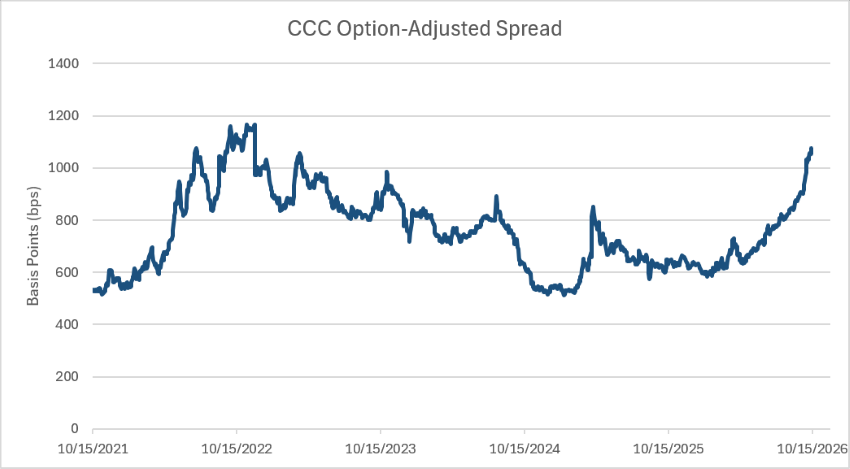
Credit markets have remained broadly resilient. Investment-grade (IG) and high-yield (HY) credit spreads are still relatively tight, with IG credit spreads near 80 to 85 basis points (bps) and HY spreads approximately 310 bps.1 At first glance, the credit market looks healthy: corporate default rates remain moderate,2 and many issuers continue to have access to capital. However, a notable divergence has emerged within the HY universe, as CCC-rated bond spreads have widened significantly, reaching roughly 1,050 bps over Treasuries.3 CCC spreads are now at a multi-year high,4 suggesting investors are becoming more cautious toward the weakest corporate borrowers. The widening shows investors are differentiating between companies with sustainable balance sheets and those whose capital structures were built for a much lower interest-rate environment.
A primary driver of this widening is the growing refinancing challenge facing highly leveraged issuers. Many CCC-rated companies have benefited from financing secured during the low-rate environment of 2020 and 2021. As those bonds mature, issuers will need to refinance debt at substantially higher rates. With the 10-year Treasury now yielding more than 5% and corporate borrowing costs significantly above pandemic-era levels,5 interest expense will likely be materially higher for many lower-rated borrowers.
At the same time, investors no longer need to venture into the riskiest segments of the market to generate attractive income. Following the rise in rates, IG bonds are yielding close to 6%, near the highest levels since 2023.6 Higher-quality BB-rated bonds also offer compelling yields with considerably lower default risk than CCC debt. As a result, investor demand for the lowest-rated securities has weakened, contributing to spread widening in the CCC segment.
This combination can be particularly challenging for CCC-rated companies, which generally have less financial flexibility, weaker free cash flow generation and fewer options for raising capital if operating performance deteriorates. The current widening suggests investors are becoming more selective and less willing to underwrite aggressive capital structures.
Key Takeaway
The market is separating interest-rate risk from credit risk. Stronger issuers continue to benefit from relatively stable access to capital and tight spreads, while weaker issuers face a growing financing premium. Wider CCC spreads signal that refinancing risk and leverage are becoming increasingly important considerations for investors. While the broader credit market remains stable, stress is building at the lowest end of the quality spectrum.
Sources:
1, 3-6Bloomberg
2LevFin Insights
This material is for informational use only. The views expressed are those of the author, and do not necessarily reflect the views of Penn Mutual Asset Management. This material is not intended to be relied upon as a forecast, research or investment advice, and it is not a recommendation, offer or solicitation to buy or sell any securities or to adopt any investment strategy.
Opinions and statements of financial market trends that are based on current market conditions constitute judgment of the author and are subject to change without notice. The information and opinions contained in this material are derived from sources deemed to be reliable but should not be assumed to be accurate or complete. Statements that reflect projections or expectations of future financial or economic performance of the markets may be considered forward-looking statements. Actual results may differ significantly. Any forecasts contained in this material are based on various estimates and assumptions, and there can be no assurance that such estimates or assumptions will prove accurate.
Investing involves risk, including possible loss of principal. Past performance is no guarantee of future results. All information referenced in preparation of this material has been obtained from sources believed to be reliable, but accuracy and completeness are not guaranteed. There is no representation or warranty as to the accuracy of the information and Penn Mutual Asset Management shall have no liability for decisions based upon such information.
High-Yield bonds are subject to greater fluctuations in value and risk of loss of income and principal. Investing in higher yielding, lower rated corporate bonds have a greater risk of price fluctuations and loss of principal and income than U.S. Treasury bonds and bills. Government securities offer a higher degree of safety and are guaranteed as to the timely payment of principal and interest if held to maturity.
All trademarks are the property of their respective owners. This material may not be reproduced in whole or in part in any form, or referred to in any other publication, without express written permission.