
When AI Became a Headwind: Dispersion and Rotation in Early 2026
February 26, 2026
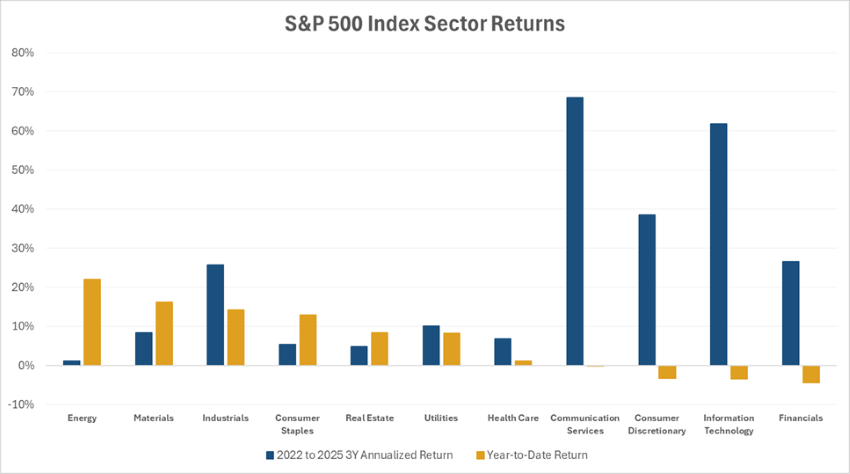
The S&P 500 Index has experienced a notable sector rotation this year, marking a clear reversal from the dominant trends of 2023 through 2025. Over the prior three years, leadership was concentrated in growth-oriented, digital-economy sectors—most prominently information technology and communication services—while more traditional, asset-heavy industries lagged.1 This year, however, cyclical and value-oriented sectors tied to the physical economy have assumed leadership. As seen in today’s Chart of the Week, energy, materials and industrials have been the top sector performers,2 benefiting from renewed investor interest in tangible asset exposure and near-term earnings visibility. By contrast, information technology and financials have lagged,3 reflecting a broad rebalancing away from crowded artificial intelligence (AI)-linked exposures.
A central catalyst behind this rotation has been the evolving impact of AI on equity valuations. In prior years, AI served as a powerful index-level tailwind, disproportionately rewarding perceived beneficiaries and driving substantial multiple expansion among mega-cap growth leaders. Optimism around AI allowed gains in “winners” to more than offset valuation compression among perceived “losers.” This year, that dynamic has reversed. Markets have grown more skeptical of companies viewed as vulnerable to AI disruption or those committing significant capital expenditures (capex) without a clear path to monetization. Meanwhile, incremental valuation upside for AI beneficiaries has become more selective. As a result, AI has transitioned from a broad-based valuation support to a source of scrutiny, particularly for companies whose multiples had embedded elevated expectations.
At the same time, investor optimism regarding the macroeconomic outlook has provided a constructive backdrop for cyclical and value stocks. Stabilizing labor markets, moderating inflation and expectations for fiscal support have reinforced confidence in the durability of the expansion. In such an environment, companies with operating leverage to industrial production, capex and commodity demand have attracted renewed capital. The rotation has also narrowed valuation spreads between traditional industries and high-growth sectors. Consequently, capital has flowed toward sectors historically associated with early- to mid-cycle economic strength.
Despite these significant undercurrents, index-level performance has remained relatively stable. As of Feb. 20, 2026, the S&P 500 Index is broadly in line with its year-end level, as strength in cyclical sectors has offset weakness among prior leaders.4 Beneath the surface, however, cross-sector dispersion has widened materially, with sharp relative performance differentials driving reallocation across style, factor and industry exposures. The net effect is a market that appears stable at the headline level yet is undergoing significant internal restructuring.
Key Takeaway
While individual stock volatility has increased meaningfully, macroeconomic-level risks do not appear elevated relative to historical norms. Economic growth remains resilient, corporate earnings momentum is constructive and financial conditions remain accommodative. This divergence has created an environment in which dispersion across companies is high even as top-down uncertainty remains moderate. Such conditions are typically conducive to active management, as evidenced by a rising share of mutual funds outperforming their benchmarks relative to recent years.5 This backdrop calls for discipline in risk identification and sizing, not a retreat from risk-taking itself.
Sources:
1-4Bloomberg
5Barclays Research; 2/19/26
This material is for informational use only. The views expressed are those of the author, and do not necessarily reflect the views of Penn Mutual Asset Management. This material is not intended to be relied upon as a forecast, research or investment advice, and it is not a recommendation, offer or solicitation to buy or sell any securities or to adopt any investment strategy.
Opinions and statements of financial market trends that are based on current market conditions constitute judgment of the author and are subject to change without notice. The information and opinions contained in this material are derived from sources deemed to be reliable but should not be assumed to be accurate or complete. Statements that reflect projections or expectations of future financial or economic performance of the markets may be considered forward-looking statements. Actual results may differ significantly. Any forecasts contained in this material are based on various estimates and assumptions, and there can be no assurance that such estimates or assumptions will prove accurate.
Investing involves risk, including possible loss of principal. Past performance is no guarantee of future results. All information referenced in preparation of this material has been obtained from sources believed to be reliable, but accuracy and completeness are not guaranteed. There is no representation or warranty as to the accuracy of the information and Penn Mutual Asset Management shall have no liability for decisions based upon such information.
High-Yield bonds are subject to greater fluctuations in value and risk of loss of income and principal. Investing in higher yielding, lower rated corporate bonds have a greater risk of price fluctuations and loss of principal and income than U.S. Treasury bonds and bills. Government securities offer a higher degree of safety and are guaranteed as to the timely payment of principal and interest if held to maturity.
All trademarks are the property of their respective owners. This material may not be reproduced in whole or in part in any form, or referred to in any other publication, without express written permission.