
The Mortgage “Mendoza Line”
March 5, 2026
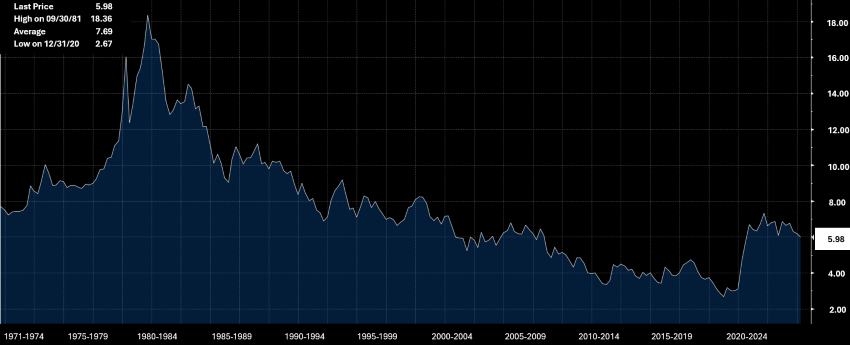
On Feb. 26, 2026, the U.S. 30-year fixed-rate mortgage dipped to 5.98%,1 marking the first time it had fallen below 6% since the third quarter of 2022.2 Many housing and mortgage market participants have been watching for this inflection point, anticipating that a mortgage rate below 6% could lead to increased housing market activity. The moment was met with enthusiasm by financial reporters; however, it is worth noting that the mortgage rate has been hovering around 6% since the beginning of this year, and as of Feb. 19, it stood at 6.01%.3 While the three-basis-point difference between 6.01% and 5.98% is modest in terms of the actual payments a homeowner would make, 6% is considered a psychological threshold. Freddie Mac’s chief economist, Sam Khater, referred to the rate move as a milestone, and Nadia Evangelou, principal economist and director of real estate research at the National Association of Realtors, cited it as “a confidence trigger for buyers.”4
The 30-year fixed-rate mortgage, which accounts for more than 90% of all mortgage originations in the U.S., peaked at 7.8% in October 2023,5 following a period of elevated inflation and a series of interest rate increases to combat it. Although 7.8% is relatively high compared with the record-low rates that characterized much of this millennium, it is in line with the long-term average of 7.69% for the period spanning 1970 to present.6 That said, a number of potential homebuyers have been sidelined over the past few years, as higher mortgage rates have limited affordability and, in many cases, made it economically compelling for existing homeowners to remain in homes for which they had previously locked in a meaningfully lower mortgage rate. This phenomenon has led to a challenging market for homebuilders, building supply companies and even retailers offering housing-related products. On its recent fourth-quarter earnings call, Home Depot management noted that the decrease in housing turnover “significantly reduced demand for projects and other purchases associated with buying and selling a home.”7
Key Takeaway
The U.S. 30-year fixed-rate mortgage crossing 6% is considered a psychological threshold for would-be homebuyers and many constituents who have been eagerly awaiting it. Coincidentally, the timing lines up well with the start of the spring selling season.
Sources:
1,6Bloomberg
2-4National Association of Realtors – Mortgage Rate Milestone: 30-Year Fixed Drops Below 6%; 2/26/26
5MarketPlace – How the 30-year fixed-rate mortgage became the U.S. standard; 6/17/25
7Yahoo! Finance – Home Depot CEO says with the housing market stalemate, ‘our customers are telling us that they’re not investing’; 2/25/26
This material is for informational use only. The views expressed are those of the author, and do not necessarily reflect the views of Penn Mutual Asset Management. This material is not intended to be relied upon as a forecast, research or investment advice, and it is not a recommendation, offer or solicitation to buy or sell any securities or to adopt any investment strategy.
Opinions and statements of financial market trends that are based on current market conditions constitute judgment of the author and are subject to change without notice. The information and opinions contained in this material are derived from sources deemed to be reliable but should not be assumed to be accurate or complete. Statements that reflect projections or expectations of future financial or economic performance of the markets may be considered forward-looking statements. Actual results may differ significantly. Any forecasts contained in this material are based on various estimates and assumptions, and there can be no assurance that such estimates or assumptions will prove accurate.
Investing involves risk, including possible loss of principal. Past performance is no guarantee of future results. All information referenced in preparation of this material has been obtained from sources believed to be reliable, but accuracy and completeness are not guaranteed. There is no representation or warranty as to the accuracy of the information and Penn Mutual Asset Management shall have no liability for decisions based upon such information.
High-Yield bonds are subject to greater fluctuations in value and risk of loss of income and principal. Investing in higher yielding, lower rated corporate bonds have a greater risk of price fluctuations and loss of principal and income than U.S. Treasury bonds and bills. Government securities offer a higher degree of safety and are guaranteed as to the timely payment of principal and interest if held to maturity.
All trademarks are the property of their respective owners. This material may not be reproduced in whole or in part in any form, or referred to in any other publication, without express written permission.