
Anchored Inflation: Key to Keeping Bond Market Tame
March 12, 2026
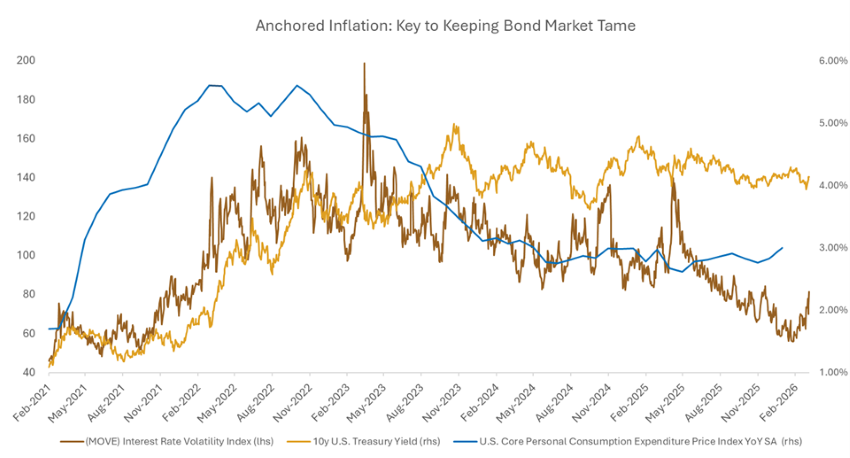
Inflation has cooled from its peak in 2022;1 however, it remains too high for the Federal Reserve (Fed) to declare victory. Currently, the Fed is less concerned about runaway inflation and more focused on ensuring inflation continues to trend lower without reigniting. With the Fed’s preferred measure of inflation, core Personal Consumption Expenditures (PCE), near 3% and nominal gross domestic product around 5%,2,3 the Fed is positioned to be a neutral factor in 2026. Though markets are pricing in a 25-basis-point rate cut by year-end,4 the current expectation is that any additional easing from the Fed in the near-term will be done within a measured, data-dependent framework rather than a rapid easing cycle. More aggressive cuts remain contingent on a material weakening in labor market conditions.
The Fed’s fight against inflation over the past several years has caused longer-term interest rates to rise, and while businesses and consumers can adapt to and even benefit from higher rates, unstable interest rates are disruptive to markets and economic activity. Stable long-term interest rates are important because they support asset prices, consumer confidence and business investment by enabling longer-term planning. Declining interest-rate volatility and the normalization of the yield curve in recent months have been a tailwind for asset prices and economic activity.
Recent events have added uncertainty to the outlook for inflation and interest rates. Oil prices and short-term inflation expectations have surged following the onset of the conflict with Iran, pushing longer-term Treasury yields higher. Meanwhile, Friday’s February jobs report raised downside risks to growth, with the economy shedding 92,000 jobs and the unemployment rate rising to 4.4% from 4.3%.5 Average hourly earnings, however, came in stronger than expected.6
Key Takeaway
The stability of longer-term interest rates will remain critical to maintaining consumer confidence, capital expenditure (capex) momentum and orderly credit conditions. Interest-rate volatility, not rate level, is the primary risk currently as the Fed continues its efforts to bring inflation back to its 2% target.
Sources:
1,4Bloomberg
2,3Strategas – Weekly Economics Summary 2/22/26
5,6CNBC – U.S. payrolls unexpectedly fell by 92,000 in February; unemployment rate rises to 4.4%; 3/6/26
This material is for informational use only. The views expressed are those of the author, and do not necessarily reflect the views of Penn Mutual Asset Management. This material is not intended to be relied upon as a forecast, research or investment advice, and it is not a recommendation, offer or solicitation to buy or sell any securities or to adopt any investment strategy.
Opinions and statements of financial market trends that are based on current market conditions constitute judgment of the author and are subject to change without notice. The information and opinions contained in this material are derived from sources deemed to be reliable but should not be assumed to be accurate or complete. Statements that reflect projections or expectations of future financial or economic performance of the markets may be considered forward-looking statements. Actual results may differ significantly. Any forecasts contained in this material are based on various estimates and assumptions, and there can be no assurance that such estimates or assumptions will prove accurate.
Investing involves risk, including possible loss of principal. Past performance is no guarantee of future results. All information referenced in preparation of this material has been obtained from sources believed to be reliable, but accuracy and completeness are not guaranteed. There is no representation or warranty as to the accuracy of the information and Penn Mutual Asset Management shall have no liability for decisions based upon such information.
High-Yield bonds are subject to greater fluctuations in value and risk of loss of income and principal. Investing in higher yielding, lower rated corporate bonds have a greater risk of price fluctuations and loss of principal and income than U.S. Treasury bonds and bills. Government securities offer a higher degree of safety and are guaranteed as to the timely payment of principal and interest if held to maturity.
All trademarks are the property of their respective owners. This material may not be reproduced in whole or in part in any form, or referred to in any other publication, without express written permission.