
Migration of the Tax Base
April 2, 2026
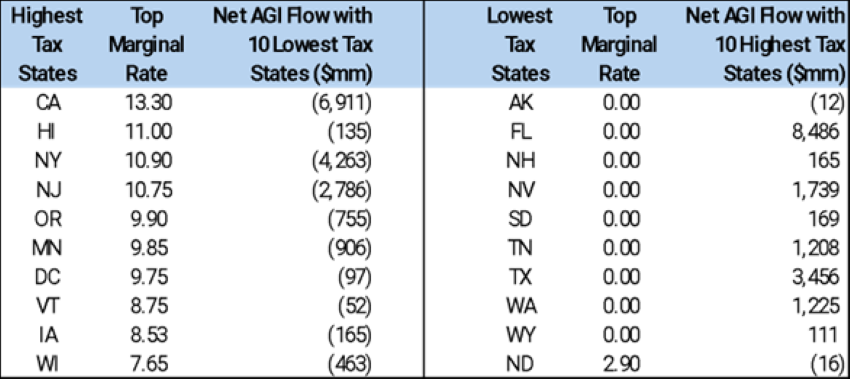
Recent shifts in state and local tax policies have intensified debates about their effect on taxpayer migration. Some jurisdictions have reduced income tax rates or adopted flat taxes, while others have raised—or threatened to raise—income tax rates. As a result, more focus has emerged on the impacts of these changes on taxpayer migration.
There are obviously many variables that factor into a decision to move to another state. One may relocate for a new job, better weather or proximity to family, in addition to tax considerations. In light of all the headlines about tax policy and potential disruption to state tax bases, the recent release of the Internal Revenue Service’s (IRS) adjusted gross income (AGI) migration data warranted a fresh look.
Today’s Chart of the Week shows the net impacts of AGI flows between states with the highest and lowest marginal income tax rates. The table shows a clear migration of AGI from high-tax to low-tax states. These flows total about $16.5 billion (B). In total, across all U.S. states, California, New York and New Jersey saw net outflows of $11.9B, $9.9B and $2.6B, respectively. Notable low-tax states like Florida and Texas saw total net inflows of $20.6B and $5.5B, respectively. Despite AGI migration from high-tax to low-tax states continuing, the margin has declined from previous IRS releases.
While this is the most recent IRS data, it is still dated, with the information coming from returns filed in 2023 for the 2022 tax year. This data could reflect the continued impacts of the pandemic and the possibility that remote work yielded elevated migration readings. However, as the availability of remote work continues to decline, so too may the migration of the labor force and tax base.
The 2017 Tax Cuts and Jobs Act, which capped the State and Local Tax (SALT) deduction at $10,000, is also likely to affect taxpayer migration. However, with the passage of the One, Big, Beautiful Bill Act and the increase in the SALT cap to $40,000 for many taxpayers through 2029, further migration out of high-income-tax states could slow. If implemented, the wealth taxes currently being proposed in various states could lead to greater AGI migration, as several high-profile billionaires have already expressed their stance and relocated.
Key Takeaway
The AGI migration trends—and their impact on the tax base—should be closely watched when analyzing the credit quality of municipal issuers. Although AGI has continued to flow from high-tax states to low-tax states, the trend has moderated relative to prior IRS data. In addition, net AGI outflows from high-tax states are small compared with total AGI. In the most recent IRS report, for example, the net outflow as a share of total state AGI was only 0.64% for California and 1.05% for New York. However, if calls to further tax high-income earners intensify, outmigration of the tax base could accelerate.
This material is for informational use only. The views expressed are those of the author, and do not necessarily reflect the views of Penn Mutual Asset Management. This material is not intended to be relied upon as a forecast, research or investment advice, and it is not a recommendation, offer or solicitation to buy or sell any securities or to adopt any investment strategy.
Opinions and statements of financial market trends that are based on current market conditions constitute judgment of the author and are subject to change without notice. The information and opinions contained in this material are derived from sources deemed to be reliable but should not be assumed to be accurate or complete. Statements that reflect projections or expectations of future financial or economic performance of the markets may be considered forward-looking statements. Actual results may differ significantly. Any forecasts contained in this material are based on various estimates and assumptions, and there can be no assurance that such estimates or assumptions will prove accurate.
Investing involves risk, including possible loss of principal. Past performance is no guarantee of future results. All information referenced in preparation of this material has been obtained from sources believed to be reliable, but accuracy and completeness are not guaranteed. There is no representation or warranty as to the accuracy of the information and Penn Mutual Asset Management shall have no liability for decisions based upon such information.
High-Yield bonds are subject to greater fluctuations in value and risk of loss of income and principal. Investing in higher yielding, lower rated corporate bonds have a greater risk of price fluctuations and loss of principal and income than U.S. Treasury bonds and bills. Government securities offer a higher degree of safety and are guaranteed as to the timely payment of principal and interest if held to maturity.
All trademarks are the property of their respective owners. This material may not be reproduced in whole or in part in any form, or referred to in any other publication, without express written permission.