
Food for Thought: Franchise ABS Keeps Relative Value On the Menu
April 9, 2026
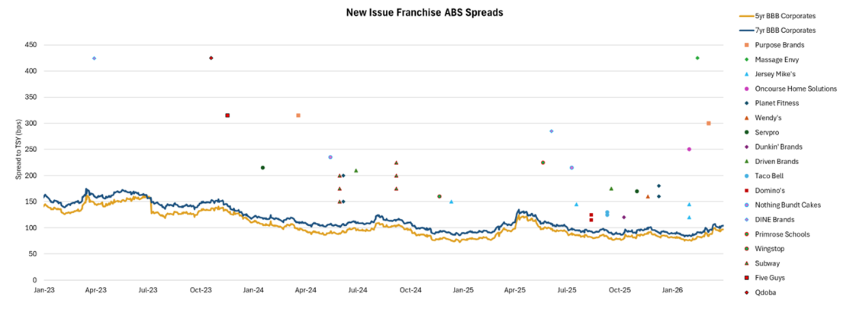
Franchise (also known as “whole business”) asset-backed securities (ABS) have become a growing share of the ABS market in recent years, with $13.5 billion and $11.0 billion issued in 2024 and 2025, respectively, up from approximately $2.3 billion in 2023.1 New issuance volume reached $2.4 billion in the first quarter of 2026 across four deals, on pace to reach close to $10 billion on an annualized basis.2 This year’s roster also featured an inaugural issuer, Oncourse Home Solutions, demonstrating a growing trend for highly franchised brands to tap this source of financing in lieu of, or in addition to, traditional corporate debt markets. Collateral for these transactions typically includes franchise revenues (issuers tend to operate the majority of their stores under franchise agreements and may include domestic and international locations) and other contractual streams of cash flows. Investors look for these transactions to de-lever naturally through sales growth, given franchise fees are typically paid as a percentage of revenue, and unit count growth, where increased systemwide revenues provide additional collateral for the ABS trust.
Today’s Chart of the Week highlights that new-issue franchise ABS deals, which usually carry a BBB+, BBB or BBB- rating and issued primarily in 5- and 7-year terms, can offer outsized returns relative to the BBB corporate debt index for similar-tenor debt. Much of this pick-up is likely explained by differences in volume and liquidity between the two markets. In March alone, $235.6 billion of investment-grade corporate bonds were issued in the U.S. versus $715.0 million for franchised ABS.3,4 For investors comfortable with this dynamic, whole business transactions also offer the unique opportunity to invest in well-known brands that may be privately owned, such as Subway and Dunkin’ Donuts which are both owned by private equity firm Roark Capital. These structures can also provide selective access to certain franchises in publicly traded companies, such as Taco Bell which is owned by public Yum! Brands alongside KFC and Pizza Hut but excluded from the Taco Bell ABS trust.
Interest in high-quality household brands extends beyond the securitized markets. In recent months, acquisition activity in franchised names has been healthy, highlighted by Blackstone’s purchase of Jersey Mike’s in 2025 and KKR’s reported acquisition of Nothing Bundt Cakes last month—both brands are active issuers in the whole business ABS market.5,6 As transaction activity persists, additional issuance from repeat borrowers or new issuers may bolster deal volume for franchise ABS.
Key Takeaway
As volume and issuer involvement expand within the franchise ABS market, investors may find relative value compared to similarly rated, unsecured traditional corporate bond debt. Trading volume and liquidity needs should be properly considered, though may be tempered as the market evolves in the medium-to-long term.
Sources:
1,2,4DB Research
3SIFMA – US Corporate Bonds Statistics; 4/1/26
5Virginia Business – Blackstone completes Jersey Mike’s Subs acquisition; 3/13/25
6Reuters – KKR to acquire Nothing Bundt Cakes for over $2 billion, source says; 3/25/26
This material is for informational use only. The views expressed are those of the author, and do not necessarily reflect the views of Penn Mutual Asset Management. This material is not intended to be relied upon as a forecast, research or investment advice, and it is not a recommendation, offer or solicitation to buy or sell any securities or to adopt any investment strategy.
Opinions and statements of financial market trends that are based on current market conditions constitute judgment of the author and are subject to change without notice. The information and opinions contained in this material are derived from sources deemed to be reliable but should not be assumed to be accurate or complete. Statements that reflect projections or expectations of future financial or economic performance of the markets may be considered forward-looking statements. Actual results may differ significantly. Any forecasts contained in this material are based on various estimates and assumptions, and there can be no assurance that such estimates or assumptions will prove accurate.
Investing involves risk, including possible loss of principal. Past performance is no guarantee of future results. All information referenced in preparation of this material has been obtained from sources believed to be reliable, but accuracy and completeness are not guaranteed. There is no representation or warranty as to the accuracy of the information and Penn Mutual Asset Management shall have no liability for decisions based upon such information.
High-Yield bonds are subject to greater fluctuations in value and risk of loss of income and principal. Investing in higher yielding, lower rated corporate bonds have a greater risk of price fluctuations and loss of principal and income than U.S. Treasury bonds and bills. Government securities offer a higher degree of safety and are guaranteed as to the timely payment of principal and interest if held to maturity.
All trademarks are the property of their respective owners. This material may not be reproduced in whole or in part in any form, or referred to in any other publication, without express written permission.