
Pain at the Pump… Are We There Yet?
April 23, 2026
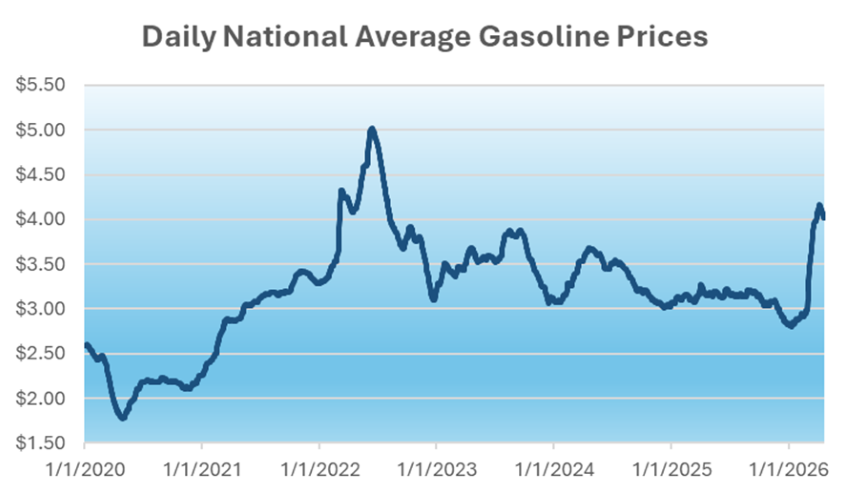
Rising gasoline prices are beginning to have a noticeable, though still manageable, impact on U.S. consumers, even as the broader economy remains relatively resilient. Since the start of Operation Epic Fury, national gasoline prices have climbed sharply, driven largely by an oil price shock tied to the geopolitical conflict in Iran and disruptions to key supply routes such as the Strait of Hormuz. Today’s Chart of the Week highlights the nearly 35% jump in gasoline prices since the conflict began, and consumers are gradually adjusting to the higher prices. Because gasoline is a necessary household expense, higher prices can reduce discretionary income at the margin, particularly for households already managing tight budgets.
The impact is more noticeable for lower-income households, which tend to spend a larger share of their income on fuel. As commuting and everyday travel become more expensive, some households may reallocate spending away from nonessential categories. Prices are rising at a time when seasonal travel increases demand. At the same time, higher fuel costs can ripple through the economy by increasing transportation and production expenses, some of which may be passed on to consumers. As a result, households could see slightly higher prices across a range of goods and services, adding to existing pressures from inflation and elevated living costs.
There are early indications that higher fuel costs are influencing consumer behavior and sentiment, though the adjustment has been gradual rather than abrupt. Some households are becoming more selective in discretionary spending such as dining, retail and entertainment. Rising prices have pushed consumer sentiment notably lower in recent months. April recorded its lowest reading in over 70 years at 47.6.1 Even so, underlying economic supports, including steady employment and recent tax-related income boosts, continue to provide a buffer that has helped sustain overall spending levels.
Macroeconomic data reflects some of these pressures. The sharp increase in energy prices was a major driver behind March’s surge in headline inflation, marking the largest monthly rise in nearly four years.2 However, oil markets have shown volatility amid evolving ceasefire discussions, suggesting current price levels may not be permanent. While supply-chain disruptions, including shipping delays, could keep prices elevated in the near term, fuel markets have historically responded relatively quickly to easing geopolitical tensions. If conditions stabilize, gasoline prices could moderate in the coming months, helping to ease pressure on consumers.
Key Takeaway
The U.S. consumer remains relatively healthy, and while higher gasoline prices are creating incremental pressure, the impact to date appears contained. Compared with previous periods of sharp increases in fuel costs, the broader economy is demonstrating greater resilience. The recent increase may prove temporary if geopolitical tensions ease and supply conditions stabilize. In the meantime, consumers may continue to make modest adjustments, but the overall economic outlook remains stable barring a prolonged period of elevated fuel prices.
Sources:
1Morningstar – Consumer Sentiment Hits Record Low, per Michigan Survey; 4/10/26
2Bloomberg – U.S. CPI Surges 0.9% in Largest Monthly Jump Since 2022 on Gas; 4/10/26
This material is for informational use only. The views expressed are those of the author, and do not necessarily reflect the views of Penn Mutual Asset Management. This material is not intended to be relied upon as a forecast, research or investment advice, and it is not a recommendation, offer or solicitation to buy or sell any securities or to adopt any investment strategy.
Opinions and statements of financial market trends that are based on current market conditions constitute judgment of the author and are subject to change without notice. The information and opinions contained in this material are derived from sources deemed to be reliable but should not be assumed to be accurate or complete. Statements that reflect projections or expectations of future financial or economic performance of the markets may be considered forward-looking statements. Actual results may differ significantly. Any forecasts contained in this material are based on various estimates and assumptions, and there can be no assurance that such estimates or assumptions will prove accurate.
Investing involves risk, including possible loss of principal. Past performance is no guarantee of future results. All information referenced in preparation of this material has been obtained from sources believed to be reliable, but accuracy and completeness are not guaranteed. There is no representation or warranty as to the accuracy of the information and Penn Mutual Asset Management shall have no liability for decisions based upon such information.
High-Yield bonds are subject to greater fluctuations in value and risk of loss of income and principal. Investing in higher yielding, lower rated corporate bonds have a greater risk of price fluctuations and loss of principal and income than U.S. Treasury bonds and bills. Government securities offer a higher degree of safety and are guaranteed as to the timely payment of principal and interest if held to maturity.
All trademarks are the property of their respective owners. This material may not be reproduced in whole or in part in any form, or referred to in any other publication, without express written permission.