
It’s Refund Season: Phase One of the Tariff Refunds Has Begun
May 21, 2026
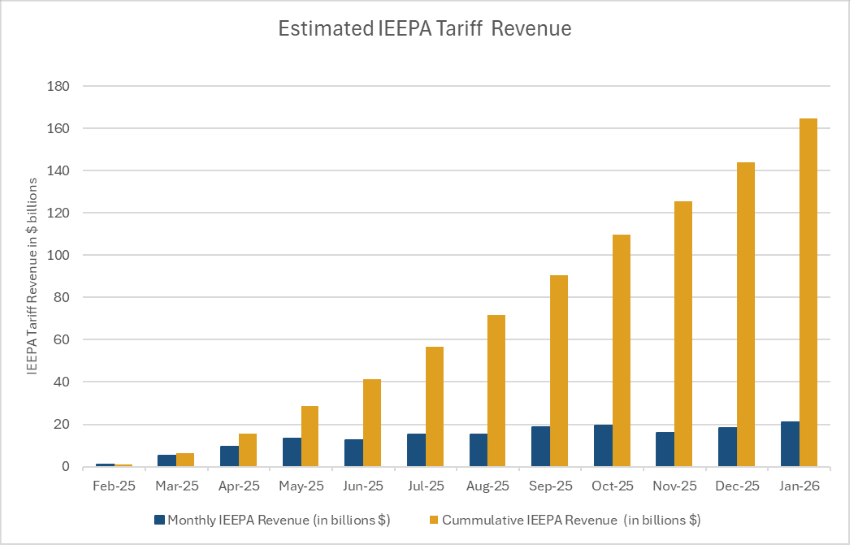
It’s that time of year again—refund season. More specifically, it is tariff refund season, as Phase One distributions related to duties under the International Emergency Economic Powers Act (IEEPA) begin to flow back to importers. Following the Supreme Court’s landmark ruling striking down the Trump administration’s use of the IEEPA to unilaterally impose import tariffs, eligible importers are moving to recover paid or deposited duties.1 Trade data indicates approximately $164.7 billion of IEEPA duties were imposed prior to the ruling.2
Before checking the mailbox, it is important to note that refunds are payable only to the importer of record.3 Impacted importers must submit refund claims through an administrative process—via electronic entries through CBP’s CAPE* module in the Automated Commercial Environment (ACE), timely Form 19 protests or other remedies—each subject to eligibility, validation and liquidation requirements.4 At a high level, this Phase One rollout aims to function as a streamlined system (CAPE) to consolidate the submission and processing of refund claims on certain entries, such as claims on entries that are unliquidated and/or within approximately 80 days of liquidation.5 The CBP notes that the more complex cases will be addressed in subsequent phases.
To better understand the progression of the IEEPA tariff recovery efforts, it may be helpful to review the trade timeline that led to this point. Beginning in February 2025, the Trump administration issued executive orders imposing emergency tariffs under IEEPA on imports from China, Mexico and Canada.6 On April 2, 2025, “Liberation Day,’’ baseline universal tariffs were introduced, shortly followed by higher country-specific reciprocal tariffs on over 57 countries.7 Tariff activity accelerated throughout 2025, with over 50 modifications to the U.S. tariff code.8 IEEPA import duties continued to accumulate, the scale of which is highlighted in today’s Chart of the Week. That was the case until Feb. 20, 2026, in a six-to-three decision, the Supreme Court ruled the executive branch cannot pass sweeping tariffs without explicit congressional approval.9 Note that this ruling applies narrowly to IEEPA as other tariffs are in place.
So where does that leave the refunds? On March 4, the U.S. Court of International Trade issued a broad refund mandate for all IEEPA duties, prompting CBP to rapidly deploy the automated CAPE system and framework to manage the anticipated volume of refunds. According to court disclosures, CBP reports that over 330,000 importers paid or deposited IEEPA duties across more than 53 million distinct entries, establishing a historical baseline pool of roughly $166 billion.10
Early processing has been underway, with tens of thousands of claims validated and an initial Phase One payout of approximately $35.5 billion, with payments beginning to reach early filers in mid-May.11
Key Takeaway
Moving forward, it will be interesting to watch how fast CBP clears the queue of potential claims and whether importers can successfully navigate the validation process in a timely manner. Given the scale and speed of this multi-billion-dollar payout, it will also be important to assess whether these refunds provide meaningful relief to affected industries, influence company-level financials or have a broader impact on economic activity.
*U.S. Customs and Border Protection’s (CBP) Consolidated Administration and Processing of Entries (CAPE)
Sources:
1,2Penn Wharton Budget Model – Supreme Court Tariff Ruling: IEEPA Revenue and Potential Refunds; 2/20/26
3,4Baker Tilly – IEEPA FAQ: Tariff refund rules, eligibility and filing steps; 4/8/26
5U.S. Customs and Border Protection – International Emergency Economic Powers Act (IEEPA) Duty Refunds; 5/20/26
6White and Case – President Trump Imposes 25% Tariffs on Canada and Mexico, and 10% Tariffs on China; 2/2/25
7Michigan Journal of Economics – “Liberation Day”: Impacts on Global Trade a Year Later; 5/11/26
8Cato at Liberty Blog – The US Tariff System Has Gotten Even More Complex—and the Supreme Court Won't Fix It; 1/9/26
9Thomson Reuters – Supreme Court tariff ruling in Learning Resources, Inc. v. Trump: What corporate tax and trade teams need to know; 2/20/26
10White & Williams – IEEPA Tariff Refunds: CBP Launches CAPE Process; 4/27/26
11Flexport – The Supreme Court’s IEEPA Tariff Ruling: Next Steps, Potential Refunds, and Guidance for Businesses; 5/12/26
This material is for informational use only. The views expressed are those of the author, and do not necessarily reflect the views of Penn Mutual Asset Management. This material is not intended to be relied upon as a forecast, research or investment advice, and it is not a recommendation, offer or solicitation to buy or sell any securities or to adopt any investment strategy.
Opinions and statements of financial market trends that are based on current market conditions constitute judgment of the author and are subject to change without notice. The information and opinions contained in this material are derived from sources deemed to be reliable but should not be assumed to be accurate or complete. Statements that reflect projections or expectations of future financial or economic performance of the markets may be considered forward-looking statements. Actual results may differ significantly. Any forecasts contained in this material are based on various estimates and assumptions, and there can be no assurance that such estimates or assumptions will prove accurate.
Investing involves risk, including possible loss of principal. Past performance is no guarantee of future results. All information referenced in preparation of this material has been obtained from sources believed to be reliable, but accuracy and completeness are not guaranteed. There is no representation or warranty as to the accuracy of the information and Penn Mutual Asset Management shall have no liability for decisions based upon such information.
High-Yield bonds are subject to greater fluctuations in value and risk of loss of income and principal. Investing in higher yielding, lower rated corporate bonds have a greater risk of price fluctuations and loss of principal and income than U.S. Treasury bonds and bills. Government securities offer a higher degree of safety and are guaranteed as to the timely payment of principal and interest if held to maturity.
All trademarks are the property of their respective owners. This material may not be reproduced in whole or in part in any form, or referred to in any other publication, without express written permission.