
New Home Sales – Disappointing or Better Than They Appear on the Surface?
June 4, 2026
The U.S. Census Bureau reported April 2026 new single-family home sales at a seasonally-adjusted annual rate of 622,000, representing a 6.2% decline from March and an 11.3% year-over-year decrease.1 Although the release was broadly viewed as disappointing, reflecting a reversal from gains posted in February and March and falling short of consensus expectations of approximately 660,000,2 the pace of new home sales does not necessarily indicate weakness. Recent data has been surprisingly consistent with historical averages. Since the mid-1960s, new home sales have averaged approximately 660,000 units on a seasonally adjusted annual basis, typically fluctuating between 400,000 and 800,000 over a full cycle.3 The April reading is only 6% below the long-term average.4 Moreover, activity since early 2024 has averaged 673,000,5 exceeding the long-term average. The new home sales data, therefore, seems at odds with the persistently negative sentiment in the housing market.
One explanation for this phenomenon may be that the current environment is being compared unfavorably to the short-lived housing “boom” that began in mid-2020 and continued through early 2021, when new home sales reached an elevated range of approximately 800,000 to 1 million units at an annualized pace.6 That period was supported by historically low mortgage rates and a heightened demand for housing during the pandemic. Since then, activity has normalized to levels that appear subdued relative to that peak.
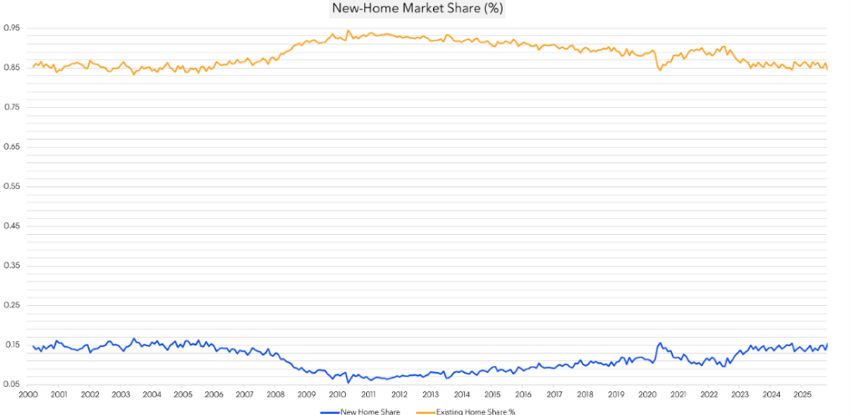
It is also worth considering that new home sales have been outperforming the broader housing market in the current environment by taking share from existing home transactions.7 Bloomberg Intelligence data indicates that new home sales have steadily increased their share in recent years, rising from pandemic-era lows and continuing higher through 2024–2026.8 While overall housing sales are muted, new homes currently account for roughly 15% of all single-family transactions,9 the high end of the National Association of Realtors’ typical range.10 Two key factors have driven this structural shift. First, elevated mortgage rates have discouraged existing homeowners from listing properties, as many remain locked into lower-rate mortgages. As a result, there is limited resale activity, and with limited resale inventory, buyers are relying more on new homes to meet demand. Second, homebuilders have responded to affordability constraints, offering incentives including mortgage rate buy-downs. These incentives reduce effective borrowing costs for buyers and help sustain demand. A mortgage buy-down is an uncommon feature in existing home sales, which makes new home sales relatively attractive to buyers—saving them money in the short term and enabling some potential buyers to qualify for loans.
Key Takeaway
In an industry generally challenged by higher interest rates, new home sales are outperforming existing home sales due to limited existing home inventory and attractive incentives offered by homebuilders.
Sources:
1U.S. Census Bureau – Monthly New Residential Sales, April 2026; 5/28/26
2Trading Economics – United States New Home Sales; May 2026
3-6,9Bloomberg
7,8Bloomberg Intelligence
10National Association of Realtors – New Construction Makes Up Record Share of Inventory; 8/22/23
This material is for informational use only. The views expressed are those of the author, and do not necessarily reflect the views of Penn Mutual Asset Management. This material is not intended to be relied upon as a forecast, research or investment advice, and it is not a recommendation, offer or solicitation to buy or sell any securities or to adopt any investment strategy.
Opinions and statements of financial market trends that are based on current market conditions constitute judgment of the author and are subject to change without notice. The information and opinions contained in this material are derived from sources deemed to be reliable but should not be assumed to be accurate or complete. Statements that reflect projections or expectations of future financial or economic performance of the markets may be considered forward-looking statements. Actual results may differ significantly. Any forecasts contained in this material are based on various estimates and assumptions, and there can be no assurance that such estimates or assumptions will prove accurate.
Investing involves risk, including possible loss of principal. Past performance is no guarantee of future results. All information referenced in preparation of this material has been obtained from sources believed to be reliable, but accuracy and completeness are not guaranteed. There is no representation or warranty as to the accuracy of the information and Penn Mutual Asset Management shall have no liability for decisions based upon such information.
High-Yield bonds are subject to greater fluctuations in value and risk of loss of income and principal. Investing in higher yielding, lower rated corporate bonds have a greater risk of price fluctuations and loss of principal and income than U.S. Treasury bonds and bills. Government securities offer a higher degree of safety and are guaranteed as to the timely payment of principal and interest if held to maturity.
All trademarks are the property of their respective owners. This material may not be reproduced in whole or in part in any form, or referred to in any other publication, without express written permission.