
Treasury Curve Shape and Credit Spreads
June 25, 2026
Last week’s first Federal Open Market Committee (FOMC) meeting under Chairman Kevin Warsh introduced notable market volatility. The market interpreted the shortened policy statement and press conference commentary as more hawkish; however, this is likely relative to expectations of a more dovish Warsh than what was ultimately conveyed in the statement. The dot plot showed participants broadly split on the direction of the next rate move, with the median policy dot plot still trending lower over time.1 Notably, Warsh did not plot his own dot on the Summary of Economic Projections, adding some uncertainty around the Federal Reserve’s (Fed) forward guidance.
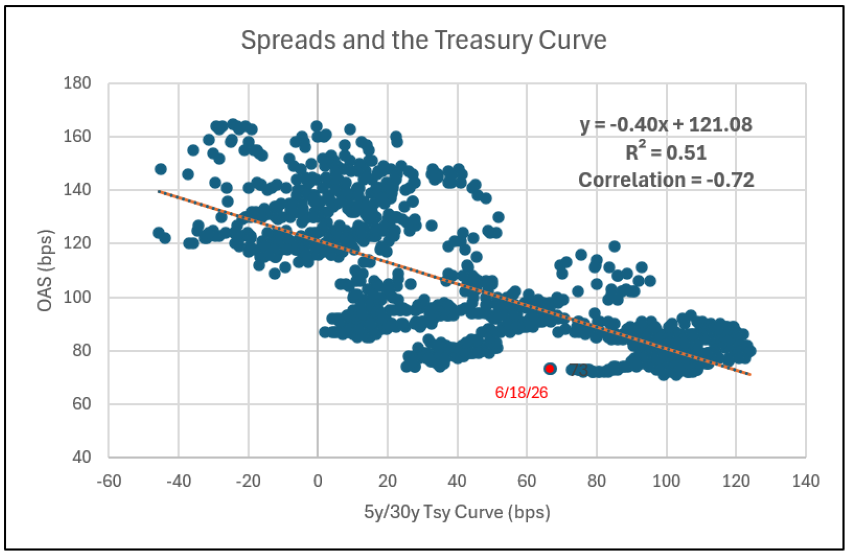
The market reacted with U.S. equities dropping by over 1%, while credit spreads remained relatively stable.2 There was, however, a fairly sharp flattening of the Treasury yield curve. Today’s Chart of the Week displays a different version of a dot plot—a scatterplot of investment-grade (IG) corporate credit spreads and the slope of the Treasury curve over the last five years. The negative beta of 0.40 indicates that a steeper Treasury curve is associated with tighter credit spreads.3 In addition, over the five-year period the correlation shows a strong negative relationship between spreads and the curve slope. The R2 of 0.51 implies a meaningful relationship for this market data and indicates the curve carries useful information about the broader macro and spreads.4
The plot also shows that the IG option-adjusted spread (OAS) appears to hit a wall in the context of current spreads in the low 70s at any slope of the Treasury curve.5 In January, spreads reached 71 OAS—the tightest level since the late 1990s—during a period when the curve was much steeper at 100 basis points (bps).6 At the steepest point in the sample (124 bps in September 2025), the OAS was 80,7 which is tight but still not at current levels.
A flatter curve typically indicates that markets are becoming more concerned about restrictive policy, tighter financial conditions and downside risks to medium-term growth. For IG credit, this dynamic is important, as slower growth can pressure revenue momentum, weigh on margins, slow earnings growth and reduce balance-sheet flexibility over time. Spreads tend to price that risk before it is fully reflected in rating actions or reported credit metrics, which helps explain why sustained curve flattening/inversion has historically coincided with wider IG spreads.
Key Takeaway
While corporate earnings have generally remained solid so far in 2026 and estimates show projected double-digit full-year earnings growth, the question becomes how much is already priced in? Earnings before interest, taxes, depreciation and amortization (EBITDA) margins and cash flow have shown steady improvement. While aggregate earnings expectations remain strong, much of the growth is being driven by technology and artificial intelligence (AI)-related companies. In addition, higher energy prices tied to Middle East tensions have pressured margins in fuel-sensitive sectors such as consumer discretionary, transportation and retail.
The current backdrop is more benign than the 2022-2023 period, when the Treasury curve was inverted, but spreads were also meaningfully wider. From current levels, further curve flattening—particularly if accompanied by increased rate volatility or weaker growth expectations—would represent a more significant headwind for IG spreads, where valuations offer limited margin for error.
Sources:
1Fox Business – Federal Reserve leaves interest rates unchanged as Warsh era begins; 6/17/26
2-7Bloomberg
This material is for informational use only. The views expressed are those of the author, and do not necessarily reflect the views of Penn Mutual Asset Management. This material is not intended to be relied upon as a forecast, research or investment advice, and it is not a recommendation, offer or solicitation to buy or sell any securities or to adopt any investment strategy.
Opinions and statements of financial market trends that are based on current market conditions constitute judgment of the author and are subject to change without notice. The information and opinions contained in this material are derived from sources deemed to be reliable but should not be assumed to be accurate or complete. Statements that reflect projections or expectations of future financial or economic performance of the markets may be considered forward-looking statements. Actual results may differ significantly. Any forecasts contained in this material are based on various estimates and assumptions, and there can be no assurance that such estimates or assumptions will prove accurate.
Investing involves risk, including possible loss of principal. Past performance is no guarantee of future results. All information referenced in preparation of this material has been obtained from sources believed to be reliable, but accuracy and completeness are not guaranteed. There is no representation or warranty as to the accuracy of the information and Penn Mutual Asset Management shall have no liability for decisions based upon such information.
High-Yield bonds are subject to greater fluctuations in value and risk of loss of income and principal. Investing in higher yielding, lower rated corporate bonds have a greater risk of price fluctuations and loss of principal and income than U.S. Treasury bonds and bills. Government securities offer a higher degree of safety and are guaranteed as to the timely payment of principal and interest if held to maturity.
All trademarks are the property of their respective owners. This material may not be reproduced in whole or in part in any form, or referred to in any other publication, without express written permission.