The American Consumer is Holding On – But For How Long?
July 9, 2026
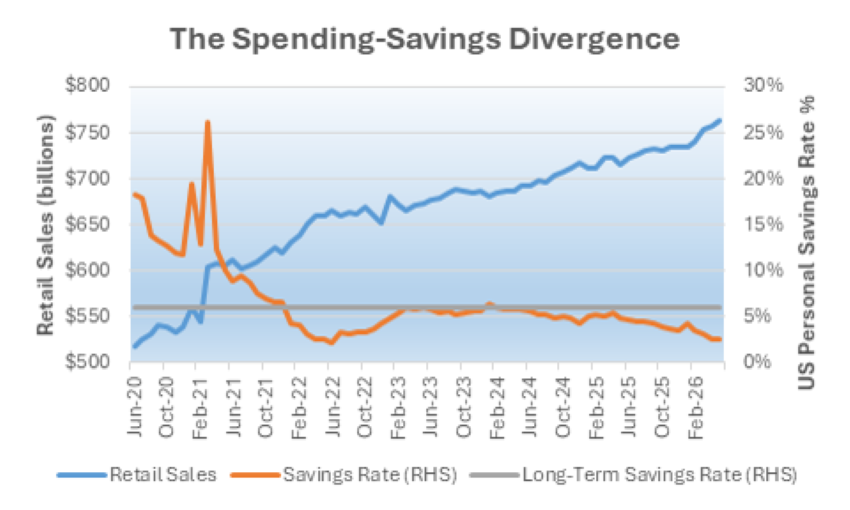
Source: Bloomberg
Note: Retail Sales are seasonally adjusted monthly retail and food services sales; Savings Rate data represent the personal saving rate as a percentage of disposable income
Consumer spending continues to rise,1 supported by a resilient U.S. labor market and steady household income growth. Unemployment remains lower by historical standards, while nominal wage gains and higher disposable income have helped consumers maintain spending levels, despite elevated interest rates and higher costs for housing, food and other essentials.2 Household wealth and strong equity market performance can also support consumer spending, with higher income households continuing to drive a disproportionate share of discretionary spending, including travel, entertainment and other non-essential purchases.3
Today’s Chart of the Week highlights a growing divergence between spending and savings behavior. Consumers are allocating a smaller share of income to savings and increasingly relying on credit to support consumption.4 Climbing expenses tied to core needs such as home costs, insurance premiums, medical care and utility bills have absorbed a larger share of household budgets, limiting the capacity to save even as wages have increased. Notably, a portion of the spending growth reflects higher prices rather than a meaningful increase in real consumption volumes.5
The excess savings accumulated during the pandemic have largely been exhausted,6 and the personal savings rate has fallen to approximately 3.0%, below its longer-term average.7 While strong employment and income trends continue to sustain consumer demand, the combination of declining savings and rising household debt raises questions about the long-term sustainability of current spending patterns. A lower savings cushion leaves households more vulnerable to economic disruptions, including job losses, market volatility or unexpected expenses.
Key Takeaway
Overall, the U.S. consumer remains resilient; however, pressure is building beneath the surface. For many households, wage growth has not kept pace with the rising cost of living, particularly in housing, insurance and healthcare. The divergence between rising retail sales and declining savings suggests consumers are increasingly dependent on current income and, to some extent, credit to sustain spending. If low savings persist alongside rising debt levels, household finances could become more vulnerable to economic shocks, potentially limiting consumers’ ability to support future economic growth.
Sources:
1, 2, 5 U.S. Bureau of Economic Analysis, Personal Income and Outlays, May 2026.
3 Federal Reserve Bank of New York, Liberty Street Economics, Tracking the K-Shaped Economy, May 1, 2026.
4 Federal Reserve Bank of New York, Household Debt and Credit Report, Q1 2026; Federal Reserve Board, Consumer Credit - G.19, April 2026.
6 Federal Reserve Bank of San Francisco, Pandemic Savings Are Gone, May 3, 2024.
7 U.S. Bureau of Economic Analysis, Personal Saving Rate; Federal Reserve Bank of St. Louis, Personal Saving Rate (PSAVERT), May 2026.
This material is for informational use only. The views expressed are those of the author, and do not necessarily reflect the views of Penn Mutual Asset Management. This material is not intended to be relied upon as a forecast, research or investment advice, and it is not a recommendation, offer or solicitation to buy or sell any securities or to adopt any investment strategy.
Opinions and statements of financial market trends that are based on current market conditions constitute judgment of the author and are subject to change without notice. The information and opinions contained in this material are derived from sources deemed to be reliable but should not be assumed to be accurate or complete. Statements that reflect projections or expectations of future financial or economic performance of the markets may be considered forward-looking statements. Actual results may differ significantly. Any forecasts contained in this material are based on various estimates and assumptions, and there can be no assurance that such estimates or assumptions will prove accurate.
Investing involves risk, including possible loss of principal. Past performance is no guarantee of future results. All information referenced in preparation of this material has been obtained from sources believed to be reliable, but accuracy and completeness are not guaranteed. There is no representation or warranty as to the accuracy of the information and Penn Mutual Asset Management shall have no liability for decisions based upon such information.
High-Yield bonds are subject to greater fluctuations in value and risk of loss of income and principal. Investing in higher yielding, lower rated corporate bonds have a greater risk of price fluctuations and loss of principal and income than U.S. Treasury bonds and bills. Government securities offer a higher degree of safety and are guaranteed as to the timely payment of principal and interest if held to maturity.
All trademarks are the property of their respective owners. This material may not be reproduced in whole or in part in any form, or referred to in any other publication, without express written permission.