
Rise of the Machines: Robotics & Physical AI Deliver Exits in Q1
July 30, 2026
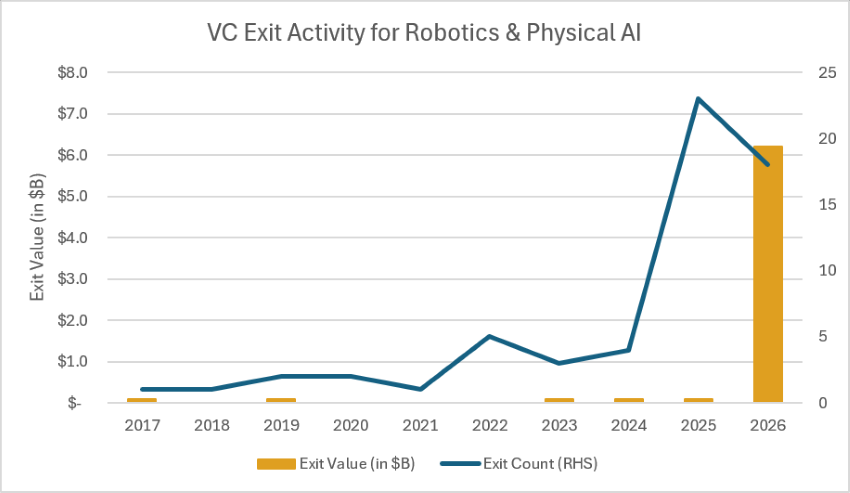
2026 is shaping up to be a potentially strong year for venture-backed robotics and physical artificial intelligence (AI) companies. As highlighted in today’s Chart of the Week, venture-backed robotics and physical AI companies generated an estimated $6.2 billion in exit value in the first quarter of 2026 alone.1 The first quarter demonstrated a material uptick in activity, with exit value exceeding the cumulative total generated by venture-backed robotics and physical AI companies between 2017 and 2025.2 These exits were realized across 18 transactions spanning a mix of exit paths, including initial public offerings (IPOs), acquisitions and buyouts.3
Before diving further into the data, it is helpful to define robotics and physical AI. Robotics refers to the development and control of physical machines and automated systems that perform tasks in various physical settings.4 Physical AI refers to the AI models, software, sensors, perception and reasoning capabilities that enable machines to perceive, understand and act within complex physical environments.5 Prior to the recent advancements in AI, robotics generally relied more heavily on rules-based programming for repetitive tasks in controlled environments.6 Although still in its early stages and somewhat limited in deployment, physical AI has the potential to enable more perceptive, effective and autonomous robotic systems across industries such as logistics, manufacturing and healthcare, among many others.
Looking ahead, several factors may support a positive long-term outlook for robotics and physical AI, including increasing real-world adoption, expanding strategic acquirer activity and use cases and strong capital flows from venture capitalists (VCs). For example, Zipline, a leading manufacturer of autonomous drone delivery systems, announced in January that it had surpassed 2 million commercial deliveries of various consumer products.7 The company also reported approximately 15% week-over-week growth in U.S. deliveries during the seven-month period leading up to the announcement.8
Additionally, strategic acquirers appear to be expanding their focus on robotics and physical AI. During the first quarter, Amazon acquired RIVR Technologies,9 a Swiss developer of last-mile delivery solutions.10 Prior to this transaction, Amazon had completed several acquisitions focused on warehouse automation and robotics.11 This recent acquisition may reflect a continued long-term commitment to robotics and suggests that strategic buyers remain interested in the potential expansion of robotics beyond warehouse environments into broader delivery use cases.
Lastly, while VCs have been allocating to the sector for some time now, recent data suggests that funding may be accelerating. Robotics companies raised a record $40.7 billion in funding in 2025, up an estimated 74% over the prior year.12 While increased funding does not guarantee the commercial success of the technology, the continued allocation of capital may signal growing confidence in the sector’s long-term opportunity. This view is further supported by industry research, where a recent report published by McKinsey estimated that advancements in robotics and physical AI could create a minimum $1 trillion in economic value by 2040.13 Together, these trends suggest growing confidence in the sector as early commercial applications continue to emerge and the underlying technology continues to advance.
Key Takeaway
The most significant aspect of the first-quarter 2026 exit activity isn't solely the volume of liquidity generated, but what it could signal about the evolution of the industry. After years of venture funding with limited exit activity, founders and investors may be beginning to see an improving exit outlook. While the sector is still in its early innings, and a single quarter of data could prove to be an outlier over time, the combination of emerging real-world use cases, advancements in AI, positive investment trends, continued strategic acquirer interest and improving liquidity may suggest that robotics and physical AI are beginning to mature as emerging technologies.
Sources:
1-3, 9PitchBook Data, Inc. – Q1 2026 Robotics & Physical AI VC Trends; 6/17/26
4-6IBM – What is Physical AI?; 1/19/26
7,8Zipline – Zipline Surpasses 2 Million Deliveries, Raises More than $600M to Power Next Phase of Growth, and Expands Operations to Houston and Phoenix; 1/21/26
10Tech Crunch – Amazon acquires Rivr, maker of a stair-climbing delivery robot; 3/19/26
11Amazon News – Amazon robotics: Meet the robots inside fulfillment centers; 6/4/26
12CB Insights Research – State of Venture 2025; 1/8/26
13McKinsey & Company – The age of thinking machines: Perspectives on the future of robotics; 6/24/26
This material is for informational use only. The views expressed are those of the author, and do not necessarily reflect the views of Penn Mutual Asset Management. This material is not intended to be relied upon as a forecast, research or investment advice, and it is not a recommendation, offer or solicitation to buy or sell any securities or to adopt any investment strategy.
Opinions and statements of financial market trends that are based on current market conditions constitute judgment of the author and are subject to change without notice. The information and opinions contained in this material are derived from sources deemed to be reliable but should not be assumed to be accurate or complete. Statements that reflect projections or expectations of future financial or economic performance of the markets may be considered forward-looking statements. Actual results may differ significantly. Any forecasts contained in this material are based on various estimates and assumptions, and there can be no assurance that such estimates or assumptions will prove accurate.
Investing involves risk, including possible loss of principal. Past performance is no guarantee of future results. All information referenced in preparation of this material has been obtained from sources believed to be reliable, but accuracy and completeness are not guaranteed. There is no representation or warranty as to the accuracy of the information and Penn Mutual Asset Management shall have no liability for decisions based upon such information.
High-Yield bonds are subject to greater fluctuations in value and risk of loss of income and principal. Investing in higher yielding, lower rated corporate bonds have a greater risk of price fluctuations and loss of principal and income than U.S. Treasury bonds and bills. Government securities offer a higher degree of safety and are guaranteed as to the timely payment of principal and interest if held to maturity.
All trademarks are the property of their respective owners. This material may not be reproduced in whole or in part in any form, or referred to in any other publication, without express written permission.