
Evergreen Funds Are Weathering Their First Stress Test
August 27, 2026
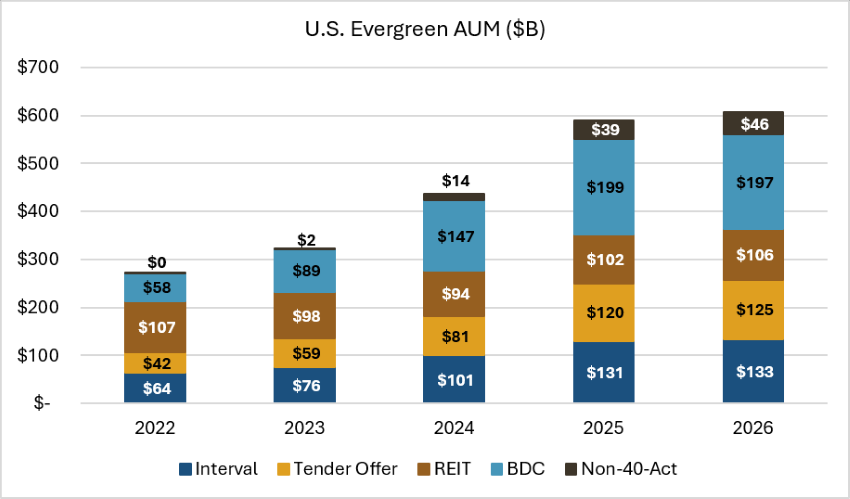
Private markets are undergoing a structural transformation in how capital is raised and accessed. Historically characterized by closed-end fund structures and decade-long lockups, private market investing was largely confined to institutional investors with the scale and operational infrastructure to manage complex commitment programs. As highlighted in today’s Chart of the Week, assets in U.S. evergreen private market funds have continued to grow to over $600 billion despite the recent wave of redemption requests affecting several high-profile semi-liquid private credit products.1 At first glance, these developments appear contradictory. In reality, they underscore both the growing importance of evergreen structures and the challenges inherent in bringing private markets to a broader investor base.
Earlier this year, several large semi-liquid private credit vehicles experienced elevated redemption requests, leading certain funds to prorate investor withdrawals and drawing heightened media scrutiny.2 While redemption activity was concentrated primarily within direct lending strategies, it occurred against a backdrop of broader uncertainty across private markets. More specifically, growing concerns around artificial intelligence (AI)-driven disruption, particularly its potential impact on software business models and valuations, prompted investors to reassess risk exposures and contributed to increased demand for liquidity.
Presently, the redemption wave appears less indicative of a structural flaw than a combination of market uncertainty and investor behavior. As redemption requests became widely publicized, additional investors sought liquidity, reinforcing the classic herd mentality that is common in any vehicle offering limited periodic redemptions. Although certain vehicles saw material redemption requests, the episode served as the first meaningful liquidity test for the evergreen ecosystem at scale, with most funds relying on existing redemption gates, portfolio cash flows and income generation rather than widespread forced asset sales, demonstrating that the structures largely functioned as intended.
The timing is particularly significant because private wealth has become one of the industry's largest growth opportunities. Traditional institutional fundraising has slowed considerably over the past several years as many pensions and endowments remain overallocated to private markets following weaker distributions and slower exit activity. By contrast, evergreen funds have continued to attract new capital by offering lower investment minimums, continuous subscriptions and periodic liquidity — features that are considerably more attractive to financial advisors and high-net-worth investors than traditional drawdown funds.
Beyond expanding access, evergreen vehicles are beginning to reshape liquidity within private markets themselves. Unlike closed-end funds that primarily deploy committed capital into new investments, many evergreen funds actively allocate to secondary transactions, continuation vehicles, net asset value (NAV) financing strategies and late-stage private companies. These investments provide liquidity to existing shareholders while creating an increasingly important source of capital for markets where companies remain private for longer. In effect, evergreen capital may become not only a fundraising vehicle, but also a permanent source of liquidity across private markets.
Key Takeaway
Evergreen funds are evolving from a product innovation into a structural component of private capital markets. The redemption pressures experienced earlier this year highlighted the importance of disciplined liquidity management and investor education, but they also demonstrated that the safeguards embedded within most evergreen structures performed largely as designed. Against a backdrop of growing demand for private wealth, expanding secondary markets and increasing investor preference for flexible investment vehicles, evergreen funds appear well-positioned to become one of the primary conduits through which capital flows into private markets over the coming decade.
Sources:
1PitchBook Data, Inc. – US Evergreen Fund Landscape; 7/7/26
2Morningstar – Semiliquid Funds: The Redemptions Made Headlines. These Are the Numbers That Matter Now; 6/16/26
This material is for informational use only. The views expressed are those of the author, and do not necessarily reflect the views of Penn Mutual Asset Management. This material is not intended to be relied upon as a forecast, research or investment advice, and it is not a recommendation, offer or solicitation to buy or sell any securities or to adopt any investment strategy.
Opinions and statements of financial market trends that are based on current market conditions constitute judgment of the author and are subject to change without notice. The information and opinions contained in this material are derived from sources deemed to be reliable but should not be assumed to be accurate or complete. Statements that reflect projections or expectations of future financial or economic performance of the markets may be considered forward-looking statements. Actual results may differ significantly. Any forecasts contained in this material are based on various estimates and assumptions, and there can be no assurance that such estimates or assumptions will prove accurate.
Investing involves risk, including possible loss of principal. Past performance is no guarantee of future results. All information referenced in preparation of this material has been obtained from sources believed to be reliable, but accuracy and completeness are not guaranteed. There is no representation or warranty as to the accuracy of the information and Penn Mutual Asset Management shall have no liability for decisions based upon such information.
High-Yield bonds are subject to greater fluctuations in value and risk of loss of income and principal. Investing in higher yielding, lower rated corporate bonds have a greater risk of price fluctuations and loss of principal and income than U.S. Treasury bonds and bills. Government securities offer a higher degree of safety and are guaranteed as to the timely payment of principal and interest if held to maturity.
All trademarks are the property of their respective owners. This material may not be reproduced in whole or in part in any form, or referred to in any other publication, without express written permission.