
The Illusion of Diversification in the Age of AI
September 3, 2026
Taught in Finance 101 classes around the globe, diversification is one of the foundational principles of modern finance. The ability to reduce idiosyncratic risk by combining assets whose returns are not perfectly correlated sits at the core of long-term portfolio construction and drives the theory behind broad index investing. Index investing is an investment strategy in which a fund seeks to track, rather than outperform, the performance of a market or a defined basket of securities. On the equity side, trillions in assets are held in S&P 500 Index funds that track and provide broad,1 diversified exposure to the largest U.S. publicly traded companies. Similar offerings are available for corporate debt, giving investors exposure to the universe of publicly issued corporate bonds. In the $47.6 trillion U.S. retirement space, index investments play an important role in generating consistent returns and supporting long-term wealth accumulation.2 However, given the increasing prevalence of artificial intelligence (AI) in financial markets, some would argue that broad index diversification is (and is increasingly becoming) an illusion, and AI is creating growing concentration in seemingly diversified portfolios.
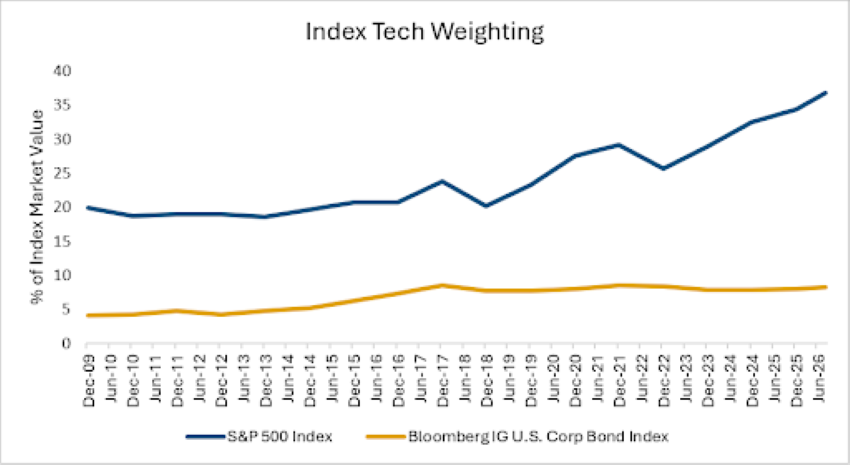
AI technology is one of the hottest topics among investors. For simplicity’s sake, it is helpful to examine the prevalence of tech and AI in a 60/40 portfolio (60% stocks, 40% corporate bonds) and the potential impacts on diversification. For the 60% equity segment, index holdings are increasingly concentrated in tech. As seen in today’s Chart of the Week, tech weight in the S&P 500 Index has grown from just under 20% in 2009 to over 37% today.3 Importantly, major players in the AI ecosystem such as Amazon, Alphabet and Meta are not included in this sector but represent over 10% of the total S&P 500 Index market cap; when considering these mega-cap companies, current equity index exposure to AI is likely understated through a pure tech lens.4 AI represents a significant opportunity for chipmakers, connectivity providers, model designers and infrastructure builders across the ecosystem. As investors have recognized the potential earnings growth from this buildout, rising valuations may be justified. However, a growing share of large equity indices is now tied, directly or indirectly, to AI adoption and spending. Any meaningful slowdown in AI-related demand could have broad and highly correlated implications across major portions of these benchmarks.
For the remaining 40% of the 60/40 portfolio, the change in tech exposure has been noticeable but a bit more modest in magnitude. Within Bloomberg’s U.S. Corporate Investment-Grade (IG) Index, tech weighting as a percentage of total market value has grown steadily from just over 4% in 2009 to over 8% today.5 Viewed through a different lens, hyperscalers, including Alphabet, Amazon, Microsoft, Meta, Oracle and SpaceX, are a growing part of the index and are increasingly focused on building out the compute capacity necessary to capture fast-growing demand. The weighting of these six issuers in Bloomberg’s IG index has increased from approximately 3.5% at year-end 2025 to just over 5% today, driven by SpaceX’s inaugural bond issuance and additional capex-related financings.6 With estimates citing trillions in future spending to build out the infrastructure necessary to support increasing compute needs, this percentage could grow meaningfully.7 Data this year has already shown increased emphasis on public debt markets to finance large-scale AI and data center projects; total U.S. dollar IG bond issuance across hyperscalers and data centers is just under $225 billion year to date, well ahead of 2025’s full-year total of $134 billion.8 As AI players become increasingly dependent on debt financing, corporate bond indices may become more concentrated in companies with credit profiles tied to the success of AI adoption.
Key Takeaway
While investors continue to benefit from broad security-level diversification, market-weighted indices are becoming increasingly concentrated in businesses linked to a common AI investment cycle. While it is true that certain tech companies operate outside of the AI ecosystem, a growing number of dependencies are being established through the infrastructure buildout. It is also worth considering that many areas outside of tech are now linked to the AI story; utilities supplying power, asset managers providing financing and construction companies are, for better or for worse, among a growing cohort of industries with AI-related operations. As a result, portfolios that appear diversified across thousands of securities and multiple asset classes may be more exposed to a single economic theme than many investors appreciate.
Sources:
1,3-6Bloomberg
2ICI – Quarterly Retirement Market Data, First Quarter 2026; 6/18/26
7Goldman Sachs – Tracking Trillions: The Assumptions Shaping the Scale of the AI Build-Out; 4/26
8Barclays – Tracking Issuance Across Asset Classes: August 2026 Update; 8/20/26
This material is for informational use only. The views expressed are those of the author, and do not necessarily reflect the views of Penn Mutual Asset Management. This material is not intended to be relied upon as a forecast, research or investment advice, and it is not a recommendation, offer or solicitation to buy or sell any securities or to adopt any investment strategy.
Opinions and statements of financial market trends that are based on current market conditions constitute judgment of the author and are subject to change without notice. The information and opinions contained in this material are derived from sources deemed to be reliable but should not be assumed to be accurate or complete. Statements that reflect projections or expectations of future financial or economic performance of the markets may be considered forward-looking statements. Actual results may differ significantly. Any forecasts contained in this material are based on various estimates and assumptions, and there can be no assurance that such estimates or assumptions will prove accurate.
Investing involves risk, including possible loss of principal. Past performance is no guarantee of future results. All information referenced in preparation of this material has been obtained from sources believed to be reliable, but accuracy and completeness are not guaranteed. There is no representation or warranty as to the accuracy of the information and Penn Mutual Asset Management shall have no liability for decisions based upon such information.
High-Yield bonds are subject to greater fluctuations in value and risk of loss of income and principal. Investing in higher yielding, lower rated corporate bonds have a greater risk of price fluctuations and loss of principal and income than U.S. Treasury bonds and bills. Government securities offer a higher degree of safety and are guaranteed as to the timely payment of principal and interest if held to maturity.
All trademarks are the property of their respective owners. This material may not be reproduced in whole or in part in any form, or referred to in any other publication, without express written permission.