
A Constructive Corporate Credit Market Though Weakness at the Edges
September 17, 2026
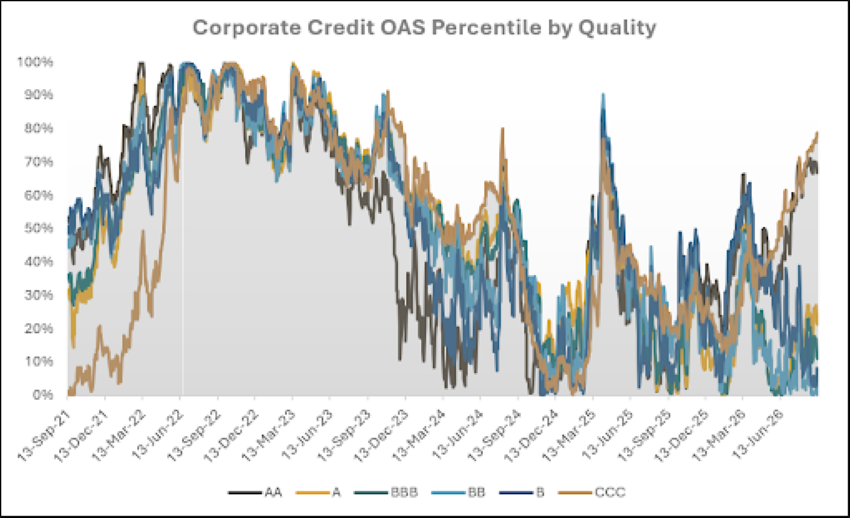
Credit markets continue to show notable bifurcation across the quality spectrum, with widening concentrated at the high end of investment-grade (IG) and the lowest tier of high yield (HY), while the middle of the ratings distribution remains near historically tight spread levels.1 As shown in today’s Chart of the Week, this dispersion highlights how pressure is concentrated in specific rating cohorts rather than across credit markets broadly. The widening in AA-rated credit spreads is largely attributable to the accelerated pace of artificial intelligence (AI)-related debt issuance, particularly from highly rated hyperscalers whose capital spending has continued to expand rapidly.
Despite this issuance, AA-rated issuers still appear fundamentally strong, with low net leverage and very high interest coverage, supported by robust growth in earnings before interest, taxes, depreciation and amortization (EBITDA) alongside the capital spending buildout.2 The key constraint for further AI-related issuance appears less fundamental than technical, for now. Hyperscaler balance sheets currently retain significant financial flexibility, so issuer concentration limits, investor capacity and market saturation around the AI theme are likely to be more important in determining how much additional debt the credit market can absorb.
Looking forward, there may be more room for balance sheet deterioration among higher-rated IG issuers as underleveraged companies shift capital allocation priorities and continue issuing debt. At the same time, a widening profitability gap has emerged across corporates, with IG firms benefiting from improving net margins while HY issuers face deteriorating margins.3 This likely reflects the advantages of scale and diversification, particularly in managing elevated commodity costs and broader input-price pressures.
Within IG, demand for credit remains solid, and the market has absorbed a heavy new-issue calendar well, including strong oversubscription levels and limited concessions despite substantial supply.4 Within HY, higher-quality issuers are holding up better than CCC-rated credits. Distressed paper now accounts for roughly 36% of the CCC cohort and trades at levels not seen since the 2008-09 global financial crisis.5
Despite the headwinds facing both ends of the corporate credit quality spectrum, broader index spreads are likely to remain range-bound in the near term, supported by attractive yields, solid earnings and macroeconomic conditions. However, a more hawkish Federal Reserve could push spreads toward the wide end of recent ranges. Volatility in rates — not the outright level of yields — is likely the more immediate risk to credit spreads.
Key Takeaway
Credit markets remain well supported by resilient demand, strong earnings and still-attractive yields. However, risks are becoming more concentrated around technical absorption of AI-related issuance, elevated rates of volatility and weakness in the lowest-quality areas of HY. Today’s Chart of the Week reinforces the need for selectivity, as dispersion remains significant even as overall credit conditions stay broadly constructive.
Sources:
1,5Barclays
2,4Bloomberg
3Goldman Sachs
This material is for informational use only. The views expressed are those of the author, and do not necessarily reflect the views of Penn Mutual Asset Management. This material is not intended to be relied upon as a forecast, research or investment advice, and it is not a recommendation, offer or solicitation to buy or sell any securities or to adopt any investment strategy.
Opinions and statements of financial market trends that are based on current market conditions constitute judgment of the author and are subject to change without notice. The information and opinions contained in this material are derived from sources deemed to be reliable but should not be assumed to be accurate or complete. Statements that reflect projections or expectations of future financial or economic performance of the markets may be considered forward-looking statements. Actual results may differ significantly. Any forecasts contained in this material are based on various estimates and assumptions, and there can be no assurance that such estimates or assumptions will prove accurate.
Investing involves risk, including possible loss of principal. Past performance is no guarantee of future results. All information referenced in preparation of this material has been obtained from sources believed to be reliable, but accuracy and completeness are not guaranteed. There is no representation or warranty as to the accuracy of the information and Penn Mutual Asset Management shall have no liability for decisions based upon such information.
High-Yield bonds are subject to greater fluctuations in value and risk of loss of income and principal. Investing in higher yielding, lower rated corporate bonds have a greater risk of price fluctuations and loss of principal and income than U.S. Treasury bonds and bills. Government securities offer a higher degree of safety and are guaranteed as to the timely payment of principal and interest if held to maturity.
All trademarks are the property of their respective owners. This material may not be reproduced in whole or in part in any form, or referred to in any other publication, without express written permission.