
Natural Resources Start to See Renewed Interest from Investors
October 1, 2026
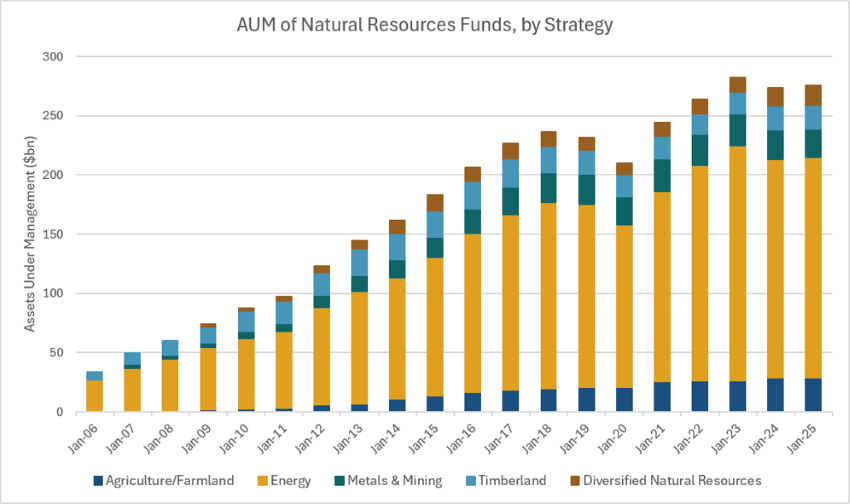
Natural resources funds have long played a role in institutional investors’ portfolios. More recently, however, various strategies within the asset class have attracted renewed interest from the investment community due to several factors, including energy security, supply chain resilience, geopolitics, artificial intelligence (AI) and resource scarcity.
When comparing natural resources to other private market strategies such as private equity, venture capital or secondaries, growth in demand and investment in real assets and natural resources funds has been slower and more volatile. The asset class has moved through various cycles that have affected both fundraising and performance. However, investors are starting to actively spend more time evaluating how natural resources can provide value to their investment portfolios.
Several events have negatively impacted demand for the sector, including the global financial crisis (2008), the oil-price crash (2016), the COVID-19 shock (2019/2020), reopening and supply-chain disruptions (2021), the war in Ukraine (2022) and the Iran conflict (2026). In addition, various environmental, social and governance initiatives over the past 10 years have led some allocators to leave the space entirely. However, it appears that demand for natural resources strategies is starting to trend upward, with allocations increasing by roughly 100% from 2021 to 2025 among a subset of institutional investors tracked by Preqin.1 Broadly, real assets strategies may offer several potential benefits to investment portfolios, including diversification, low correlation to the broader equity and credit markets and inflation-hedging, to name a few.
In areas such as upstream and midstream oil and gas, given the volatility in returns and inherent cyclicality of the strategy, several investment managers have left the space, leaving relatively few general partners (GPs) solely focused on oil and gas. As a result of the diminished competition for assets, as well as the complexity of identifying opportunities and building businesses in the sector, valuations have become relatively attractive compared with other sectors within private equity or venture capital.
Limited partners (LPs) allocate to natural resources for a variety of reasons. Below is a high-level representation of what various strategies within real assets may provide to investors and why allocators are looking to add these types of strategies to their portfolios:
- Energy Funds: Potentially higher returns but more risk – offer direct leverage to commodity prices but come with high volatility
- Metal and Mining Funds: Scarcity exposure – provide access to supply bottlenecks, electrification demand and commodity-price upside, while requiring tolerance for cyclicality
- Timberland Funds: Defensive real asset exposure – biological growth, land value, lower correlation to traditional markets, with stable income as harvest timing helps smooth price volatility
- Agriculture/Farmland Funds: Income and resilience – land-backed exposure to food demand and inflation, with predictable income from leasing or crop sales
- Water and Diversified Natural Resources Funds: Flexible allocations help balance return, income, inflation sensitivity and diversification across the resource cycle
In addition, the cash-flow-oriented nature of many of these strategies has made the asset class more attractive to investors, particularly for LPs with outsized exposure to private equity, growth and venture capital, where exits have been harder to come by in recent years. The quicker and more consistent cash flow profile (limited J-curve) of natural resources strategies allows LPs to more definitively forecast liquidity, investment pacing, as well as recycling across their respective portfolios. However, LPs remain selective in who they choose to partner with, whether it be generalists or specialists, the strength of a manager’s sourcing networks, management team expertise and ability, as well as overall differentiation in strategy and portfolio construction.
Key Takeaway
As investors across the private markets continue to evaluate where they are spending time, in addition to where capital is being invested, natural resources funds are seeing increased demand from the institutional investment community. Several factors are driving this interest, including the positive cash flow nature of real assets, portfolio diversification, inflation hedging and lower correlation to the broader equity and credit markets.
In addition, given the illiquidity and limited exits from private equity, growth and venture capital funds in recent vintages, LPs are increasingly exploring alternative sources of liquidity and return. From an assets-under-management perspective, it will take a long time for natural resources to ultimately catch up to where private equity or venture capital allocations may lie for institutional investors. However, there are a number of tailwinds in real assets broadly, which could continue to attract investors over the medium to long term.
Sources:
1Preqin – Strategy in Focus: Natural Resources; 8/26/26
This material is for informational use only. The views expressed are those of the author, and do not necessarily reflect the views of Penn Mutual Asset Management. This material is not intended to be relied upon as a forecast, research or investment advice, and it is not a recommendation, offer or solicitation to buy or sell any securities or to adopt any investment strategy.
Opinions and statements of financial market trends that are based on current market conditions constitute judgment of the author and are subject to change without notice. The information and opinions contained in this material are derived from sources deemed to be reliable but should not be assumed to be accurate or complete. Statements that reflect projections or expectations of future financial or economic performance of the markets may be considered forward-looking statements. Actual results may differ significantly. Any forecasts contained in this material are based on various estimates and assumptions, and there can be no assurance that such estimates or assumptions will prove accurate.
Investing involves risk, including possible loss of principal. Past performance is no guarantee of future results. All information referenced in preparation of this material has been obtained from sources believed to be reliable, but accuracy and completeness are not guaranteed. There is no representation or warranty as to the accuracy of the information and Penn Mutual Asset Management shall have no liability for decisions based upon such information.
High-Yield bonds are subject to greater fluctuations in value and risk of loss of income and principal. Investing in higher yielding, lower rated corporate bonds have a greater risk of price fluctuations and loss of principal and income than U.S. Treasury bonds and bills. Government securities offer a higher degree of safety and are guaranteed as to the timely payment of principal and interest if held to maturity.
All trademarks are the property of their respective owners. This material may not be reproduced in whole or in part in any form, or referred to in any other publication, without express written permission.