
Record Consumer Credit: A Sign of Resilience or Growing Strain?
October 8, 2026
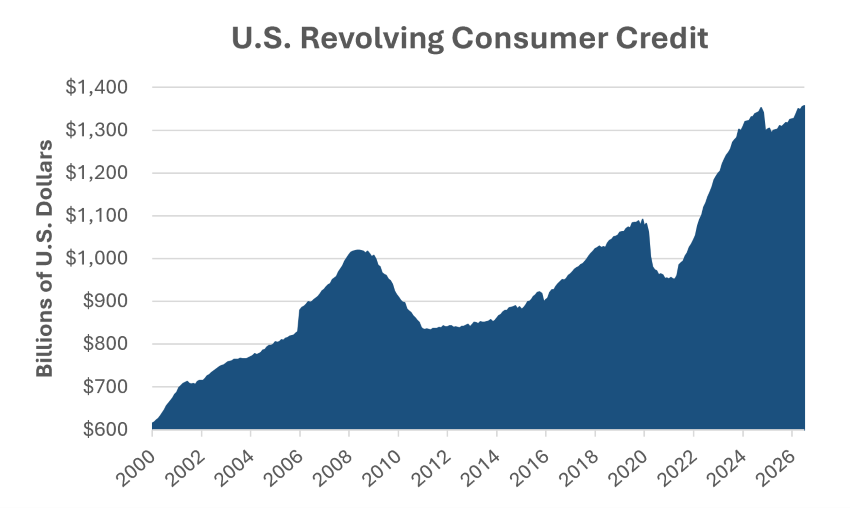
U.S. revolving consumer credit, primarily credit card debt, has climbed to a record level. As seen in today’s Chart of the Week, balances increased from approximately $950 billion in early 2021 to more than $1.35 trillion in 2026.1 Although revolving credit has generally trended upward over the past quarter-century, the pace of growth accelerated markedly after 2021. This rapid expansion reflects resilient consumer spending but may also suggest a growing reliance on high-cost borrowing as pandemic-era savings fade and household budgets remain under pressure.
The sharp increase beginning in 2022 coincided with elevated inflation, rising costs for essential goods and services and the gradual depletion of pandemic-era excess savings. As excess savings were depleted, many households increasingly turned to revolving credit to sustain consumption. Revolving credit balances have continued to rise even as credit card interest rates remain elevated, increasing the cost of carrying debt for borrowers who do not pay their balances in full. Federal Reserve data shows that the average commercial bank credit card rate on accounts assessed interest was 22.15% in the second quarter of 2026.2
So far, relatively stable labor market conditions, low unemployment and continued, albeit slowing, wage growth have helped many consumers manage higher debt balances. Real consumer spending has remained resilient despite tighter financial conditions.3 However, aggregate strength may mask increasing dispersion across consumers. Higher-income households generally retain stronger balance sheets and greater financial flexibility, while lower-income borrowers are more vulnerable to rising living costs, elevated interest rates and growing debt burdens.
The increase in revolving credit balances presents both support and risk for the economic outlook. Credit availability is supporting near-term consumption, but greater reliance on high-cost debt may make some households more vulnerable to weaker employment, slower income growth or persistently high interest rates. A low personal saving rate also leaves less capacity to absorb job losses, market volatility or unexpected expenses.
For asset-backed securities investors, record revolving credit balances are not inherently problematic. Larger balances often reflect a combination of nominal income growth, inflation and continued consumer spending rather than financial distress alone. The more important question is whether borrowers can continue to service their obligations. Employment conditions, wage growth, household liquidity, credit card utilization rates, delinquencies, charge-offs and debt service burdens remain the key indicators of future consumer credit performance. Rising balances become concerning primarily if they are accompanied by weakening repayment behavior or labor market deterioration.
Key Takeaway
U.S. revolving consumer credit has reached a record high, reflecting both resilient consumer spending and a growing reliance on borrowing following the depletion of pandemic-era savings. While stable employment and wage growth continue to support consumer credit performance, the rapid increase in balances leaves some households more sensitive to economic stress than in recent years. The consumer remains broadly healthy, but credit performance will increasingly depend on income growth and employment stability. For investors, the key issue is not the absolute level of debt, but whether income growth, labor market conditions and household liquidity remain sufficient to support repayment capacity.
Sources:
1Federal Reserve Bank of St. Louis (FRED) – Revolving Consumer Credit Owned and Securitized (REVOLSL); as of 9/8/26
2Board of Governors of the Federal Reserve System – Consumer Credit – G.19, July 2026; 9/8/26
3U.S. Bureau of Economic Analysis – Personal Income and Outlays, August 2026; 9/30/26
This material is for informational use only. The views expressed are those of the author, and do not necessarily reflect the views of Penn Mutual Asset Management. This material is not intended to be relied upon as a forecast, research or investment advice, and it is not a recommendation, offer or solicitation to buy or sell any securities or to adopt any investment strategy.
Opinions and statements of financial market trends that are based on current market conditions constitute judgment of the author and are subject to change without notice. The information and opinions contained in this material are derived from sources deemed to be reliable but should not be assumed to be accurate or complete. Statements that reflect projections or expectations of future financial or economic performance of the markets may be considered forward-looking statements. Actual results may differ significantly. Any forecasts contained in this material are based on various estimates and assumptions, and there can be no assurance that such estimates or assumptions will prove accurate.
Investing involves risk, including possible loss of principal. Past performance is no guarantee of future results. All information referenced in preparation of this material has been obtained from sources believed to be reliable, but accuracy and completeness are not guaranteed. There is no representation or warranty as to the accuracy of the information and Penn Mutual Asset Management shall have no liability for decisions based upon such information.
High-Yield bonds are subject to greater fluctuations in value and risk of loss of income and principal. Investing in higher yielding, lower rated corporate bonds have a greater risk of price fluctuations and loss of principal and income than U.S. Treasury bonds and bills. Government securities offer a higher degree of safety and are guaranteed as to the timely payment of principal and interest if held to maturity.
All trademarks are the property of their respective owners. This material may not be reproduced in whole or in part in any form, or referred to in any other publication, without express written permission.