Leveraged and Single-Stock ETFs Continue to Gain Scale
October 29, 2026
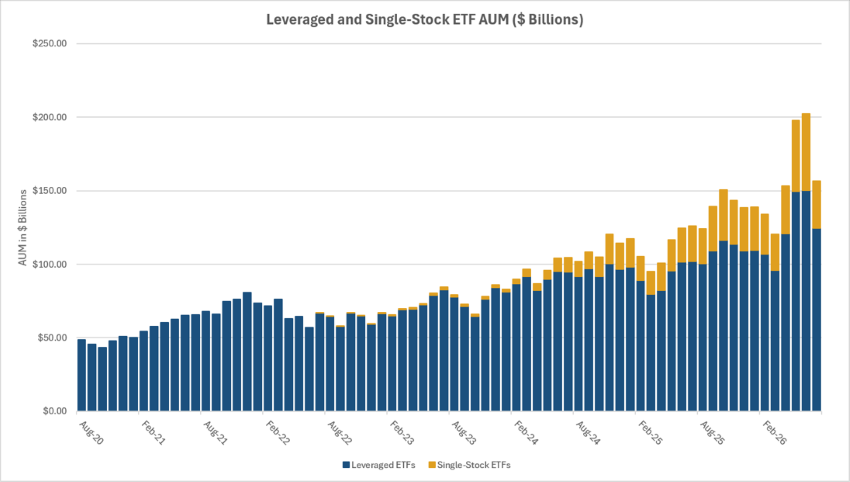
Assets in U.S. leveraged and single-stock exchange-traded funds (ETFs) briefly reached record levels of approximately $150.31 billion and $51.88 billion, respectively, in June 2026.1 The growth reflected in today's Chart of the Week highlights the continued evolution of the ETF wrapper as a vehicle for expressing targeted views on sectors, themes and individual companies. While leveraged ETFs have existed for nearly two decades, single-stock ETFs first launched in the U.S. in 2022 and have become a rapidly growing segment of the ETF market.2 According to Morningstar, leveraged and single-stock ETFs account for a significant share of 2026 ETF prospectus filings.3 As these products continue to gain scale, their volatile characteristics and implications for markets are drawing attention from investors, issuers and regulators.
Much of the activity is driven by retail investors, who reportedly account for nearly 90% of trading volume in leveraged single-stock ETFs.4 The appeal appears to stem from the ability for this investor cohort to gain concentrated or leveraged exposure through the convenient ETF wrapper, although these potential benefits are accompanied by additional risks. These products offer intraday trading and access to specialized exposures or structures that could be challenging to recreate otherwise. Leveraged ETFs may also provide capital-efficient exposure without requiring investors to maintain margin accounts or trade derivatives directly.5
This convenience is also accompanied by additional risks. Leverage can magnify both gains and losses, and single-stock exposure lacks the diversification of a broad-market fund. Because many leveraged ETFs target daily returns, the Securities and Exchange Commission notes that daily resets and compounding can cause leveraged ETF performance over longer holding periods to differ considerably from the stated leverage multiple, particularly during periods of elevated volatility.6 Assets in both leveraged and single-stock ETFs have remained heavily skewed toward long-oriented strategies, suggesting investors may primarily utilize these products to express bullish views rather than for hedging or risk management.7
The South Korean market offers a useful example of both the opportunities and challenges associated with the rapid growth of leveraged and single-stock ETFs. Recent investor enthusiasm surrounding artificial intelligence, semiconductors and related technology investments drove substantial capital into Korean equities, particularly Samsung Electronics and SK Hynix, which together accounted for 42.2% of the Korea Composite Stock Price Index (KOSPI) in May.8 However, when sentiment reversed during this summer’s chip-stock selloff, the KOSPI fell nearly 35% over the course of a month, with losses amplified for leveraged products.9 This volatile period drew increased local regulatory scrutiny of leveraged investment products and highlighted the complexity of these structures, as well as how concentrated exposures and leverage can amplify risk during periods of stress.10
Key Takeaway
While leveraged ETFs have existed for nearly two decades, single-stock ETFs represent a newer and rapidly growing segment of the ETF market. Record asset levels in both categories may suggest investors continue to seek increasingly targeted, capital-efficient ways to express market views.
The growth of these products highlights the continued evolution of the ETF market and its appeal across different investor cohorts, particularly retail investors. While these vehicles provide convenient access to specialized exposures, they also introduce additional risks related to leverage, concentration and volatility, making them an increasingly important area for investors and regulators to monitor as adoption may continue to expand.
Sources:
1,7Bloomberg
2Reuters (via Yahoo Finance) – Explainer: What are leveraged ETFs and how are they driving South Korean markets?; 7/29/26
3Morningstar – The State of the US ETF Market 2026
4Reuters (via Yahoo Finance) – US retail investors fuel surge in leveraged ETF trading, study shows; 2/24/26
5SEC Investor Advisory Committee – Recommendation of the Market Structure Subcommittee of the SEC Investor Advisory Committee on Single Stock ETFs and Leveraged ETFs; 6/22/23
6Investor.gov – Updated Investor Bulletin: Leveraged and Inverse ETFs
8CNBC – Asia’s trillion-dollar titans are powering — and distorting — its fastest growing stock markets; 5/12/26
9,10CNBC – Minister apologizes as Korean leveraged ETF investors nurse heavy losses amid chip stock rout; 7/29/26
This material is for informational use only. The views expressed are those of the author, and do not necessarily reflect the views of Penn Mutual Asset Management. This material is not intended to be relied upon as a forecast, research or investment advice, and it is not a recommendation, offer or solicitation to buy or sell any securities or to adopt any investment strategy.
Opinions and statements of financial market trends that are based on current market conditions constitute judgment of the author and are subject to change without notice. The information and opinions contained in this material are derived from sources deemed to be reliable but should not be assumed to be accurate or complete. Statements that reflect projections or expectations of future financial or economic performance of the markets may be considered forward-looking statements. Actual results may differ significantly. Any forecasts contained in this material are based on various estimates and assumptions, and there can be no assurance that such estimates or assumptions will prove accurate.
Investing involves risk, including possible loss of principal. Past performance is no guarantee of future results. All information referenced in preparation of this material has been obtained from sources believed to be reliable, but accuracy and completeness are not guaranteed. There is no representation or warranty as to the accuracy of the information and Penn Mutual Asset Management shall have no liability for decisions based upon such information.
High-Yield bonds are subject to greater fluctuations in value and risk of loss of income and principal. Investing in higher yielding, lower rated corporate bonds have a greater risk of price fluctuations and loss of principal and income than U.S. Treasury bonds and bills. Government securities offer a higher degree of safety and are guaranteed as to the timely payment of principal and interest if held to maturity.
All trademarks are the property of their respective owners. This material may not be reproduced in whole or in part in any form, or referred to in any other publication, without express written permission.