Similar Mortgages, Different Wrapper, Different Prices
November 5, 2026
Most U.S. homebuyers care deeply about where their home is located, but relatively few give much thought to where their mortgage comes from or where it goes after closing. U.S. households carry approximately $14 trillion of residential mortgage debt,1 the majority of which (about $9.3 trillion) is guaranteed by Ginnie Mae or the government-sponsored enterprises (GSEs) Fannie Mae and Freddie Mac and securitized in the agency mortgage-backed securities (MBS) market before being sold to institutional investors.2 Another $4 trillion or so of residential mortgages is purchased outright by institutional investors, which then own them as assets in their original whole-loan form.3 For remaining mortgages that end up in neither agency MBS nor whole loans, the non-agency residential mortgage-backed securities (RMBS) market represents a smaller but faster-growing source of financing.
The non-agency RMBS market surpassed $800 billion in size this year, and its expected net issuance of about $110 billion is over half the size of expected net issuance for the entire agency MBS market.4 While the non-agency RMBS market includes mortgage products ineligible for agency MBS securitization, such as non-qualified mortgages (non-QM), there has been a growing trend of agency-eligible collateral being issued in non-agency RMBS securitizations rather than being delivered to the GSEs.
The two main types of agency-eligible collateral moving into non-agency RMBS securitizations are agency-eligible investor loans and agency-conforming owner-occupied loans. Non-agency issuance of agency-eligible collateral totaled $6.4 billion in 2024, doubled to $12.8 billion in 2025 and could approach $20 billion in 2026.5 Three factors are driving this trend:
- Better execution: After accounting for the loan-level price adjustments (LLPAs) charged by the GSEs, execution in the non-agency market can be better for certain types of collateral, particularly investor loans.
- Real estate investment trust (REIT) participation: Several frequent issuers are REITs, which typically sell the higher-rated bonds of their non-agency securitizations and retain the subordinate bonds, effectively creating their own leveraged exposure to residential mortgage credit.
- Funding diversification: Guarantee fees (g-fees), the charges lenders pay to the GSEs or Ginnie Mae to guarantee a loan, have risen in recent years and remain subject to policy changes. By establishing a non-agency RMBS platform, originators can diversify their funding sources and reduce reliance on the agency channel.
Key Takeaway
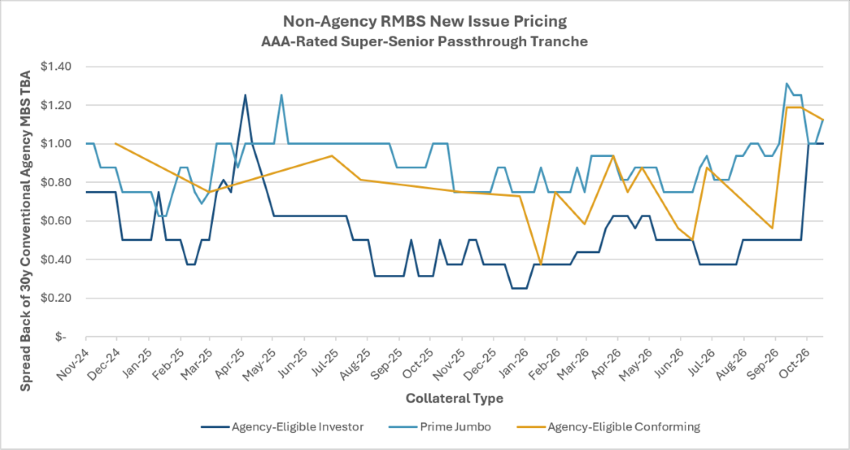
When identical collateral is securitized in the non-agency RMBS market rather than the agency MBS market, one major difference is the presence of credit risk, since agency MBS carry the implicit or explicit guarantee of the U.S. government. Today’s Chart of the Week demonstrates the additional spread, measured as a discount to agency MBS, that investors gain by investing in the non-agency versions. A second consideration is liquidity risk: the agency MBS market is far larger and more liquid. For institutional investors, the non-agency RMBS market can offer interesting relative-value opportunities to capture additional spread relative to agency MBS through the presence of credit and liquidity risk.
Sources:
1Board of Governors of the Federal Reserve System – Financial Accounts of the United States (Z.1), Second Quarter 2026; 9/11/26
2Morgan Stanley Research
3Urban Institute – Housing Finance at a Glance: A Monthly Chartbook, October 2026; 10/30/26
4,5Bank of America Global Research
This material is for informational use only. The views expressed are those of the author, and do not necessarily reflect the views of Penn Mutual Asset Management. This material is not intended to be relied upon as a forecast, research or investment advice, and it is not a recommendation, offer or solicitation to buy or sell any securities or to adopt any investment strategy.
Opinions and statements of financial market trends that are based on current market conditions constitute judgment of the author and are subject to change without notice. The information and opinions contained in this material are derived from sources deemed to be reliable but should not be assumed to be accurate or complete. Statements that reflect projections or expectations of future financial or economic performance of the markets may be considered forward-looking statements. Actual results may differ significantly. Any forecasts contained in this material are based on various estimates and assumptions, and there can be no assurance that such estimates or assumptions will prove accurate.
Investing involves risk, including possible loss of principal. Past performance is no guarantee of future results. All information referenced in preparation of this material has been obtained from sources believed to be reliable, but accuracy and completeness are not guaranteed. There is no representation or warranty as to the accuracy of the information and Penn Mutual Asset Management shall have no liability for decisions based upon such information.
High-Yield bonds are subject to greater fluctuations in value and risk of loss of income and principal. Investing in higher yielding, lower rated corporate bonds have a greater risk of price fluctuations and loss of principal and income than U.S. Treasury bonds and bills. Government securities offer a higher degree of safety and are guaranteed as to the timely payment of principal and interest if held to maturity.
All trademarks are the property of their respective owners. This material may not be reproduced in whole or in part in any form, or referred to in any other publication, without express written permission.