High-Yield Credit Looks Expensive… Until You Look at Yields
November 12, 2026
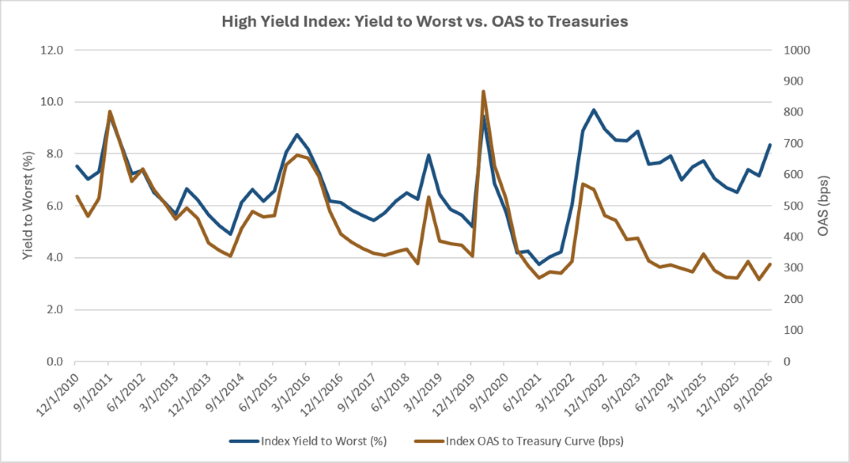
From 2011 to 2021, the yield and the option-adjusted spread (OAS) over Treasuries of the Bloomberg U.S. Corporate High Yield Index generally moved together, rising during periods of stress such as 2011 and 2020, and falling as markets recovered. That relationship has broken down over the past few years, and the divergence has become even more pronounced in 2026, with the index experiencing below-average spreads but above-average yields. The current yield to worst (YTW) of the index is 8.3%, 24% above its 6.7% average since 2011, while the OAS of 335 basis points (bps) is approximately 20% below the average OAS over the same period.1
Elevated Treasury yields help explain the divergence. The Federal Reserve raised rates in September for the first time since 2023,2 and the 10-year Treasury yield ended October at 4.93% after reaching 5.29% at the end of September.3 Corporate credit spreads, meanwhile, remain historically tight, suggesting expensive valuations relative to Treasuries. Even so, elevated Treasury yields allow investors to earn attractive all-in yields despite receiving relatively little incremental compensation for assuming the corporate credit risk.
Key Takeaway
Investors are not necessarily being paid much for taking credit risk, but they are being paid well for owning bonds.
Sources:
1,3Bloomberg
2CNBC – Fed approves interest rate hike, signals one more to come this year; 9/16/26
This material is for informational use only. The views expressed are those of the author, and do not necessarily reflect the views of Penn Mutual Asset Management. This material is not intended to be relied upon as a forecast, research or investment advice, and it is not a recommendation, offer or solicitation to buy or sell any securities or to adopt any investment strategy.
Opinions and statements of financial market trends that are based on current market conditions constitute judgment of the author and are subject to change without notice. The information and opinions contained in this material are derived from sources deemed to be reliable but should not be assumed to be accurate or complete. Statements that reflect projections or expectations of future financial or economic performance of the markets may be considered forward-looking statements. Actual results may differ significantly. Any forecasts contained in this material are based on various estimates and assumptions, and there can be no assurance that such estimates or assumptions will prove accurate.
Investing involves risk, including possible loss of principal. Past performance is no guarantee of future results. All information referenced in preparation of this material has been obtained from sources believed to be reliable, but accuracy and completeness are not guaranteed. There is no representation or warranty as to the accuracy of the information and Penn Mutual Asset Management shall have no liability for decisions based upon such information.
High-Yield bonds are subject to greater fluctuations in value and risk of loss of income and principal. Investing in higher yielding, lower rated corporate bonds have a greater risk of price fluctuations and loss of principal and income than U.S. Treasury bonds and bills. Government securities offer a higher degree of safety and are guaranteed as to the timely payment of principal and interest if held to maturity.
All trademarks are the property of their respective owners. This material may not be reproduced in whole or in part in any form, or referred to in any other publication, without express written permission.