
The Treasury Yield Curve Has Risen and Flattened in 2026
May 28, 2026
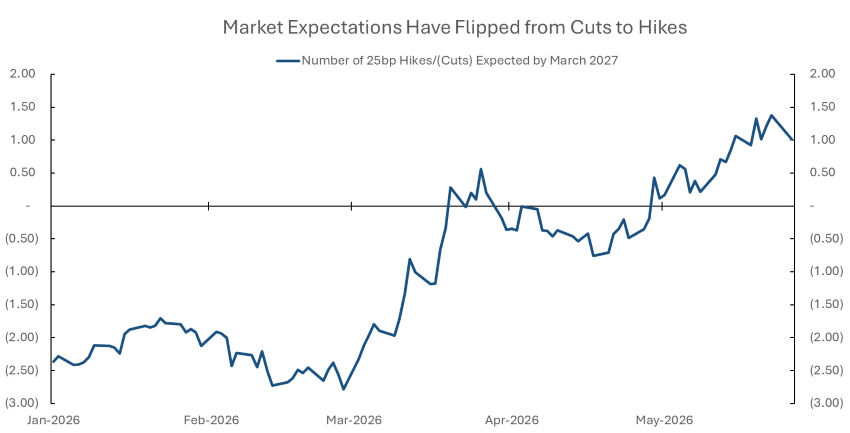
At the start of the year, markets were pricing in multiple 25-basis-point interest rate cuts from the Federal Reserve (Fed). Core personal consumption expenditures (PCE)—the Fed’s preferred measure of inflation—came in below or near 3% throughout 2025,1 and expectations following Kevin Warsh’s nomination in January were that the incoming Fed Chair would push for lower rates once his term started in May. Benchmark Treasury yields reached year-to-date lows at the end of February, with yields on 2-, 10- and 30-year Treasuries falling to 3.37%, 3.94% and 4.61%, respectively.2
By the week leading into Memorial Day and the unofficial start of summer, that backdrop has shifted. Treasury yields have hit their 2026 highs, with the 2-year at 4.12%, 10-year at 4.67% and 30-year at 5.18%.3 Today’s Chart of the Week, which derives its data from pricing on federal funds rate futures contracts, shows that markets have priced out near-term interest rate cuts and are now pricing in interest rate hikes.4 This repricing has driven Treasury yields higher and the yield curve to flatten, as short-term interest rates have risen more than long-term rates.
On the surface, this move higher in interest rates alongside an over 50% increase in oil prices since the conflict in Iran began might seem like an inflation story.5 And while core PCE has trended upward in March to 3.2% year-over-year,6 much of this move in interest rates has been attributed to a rise in real rates, rather than inflation expectations. Risk assets have performed strongly; after a pullback in March, equities have rallied to new all-time highs in May,7 while corporate credit spreads have tightened back near multi-decade lows.8 The first quarter 2026 earnings season has been exceptionally strong, and the strength in risk assets suggests the market is looking past the pain at the gas pump and toward continued expansion in the U.S. economy.
The rise in Treasury rates has presented an opportunity for fixed-income investors to capitalize on higher all-in yields. Robust demand for income has compressed credit spreads—the incremental yield bonds offer over comparable-duration Treasuries—across most fixed-income sectors. Spreads to Treasuries at the long end of the curve—where yields are highest—have compressed further relative to those on shorter-duration bonds.
Key Takeaway
Shorter-dated Treasury yields have risen more than those on longer maturities, while credit curves have flattened. As a result, investors are now earning higher yields across fixed income than they were at the start of the year, though relative value has shifted as moves in Treasury yields and credit curves have altered where investors are finding that additional yield.
Sources:
1,6Bureau of Economic Analysis – Personal Consumption Expenditures Price Index, Excluding Food and Energy; March 2026
2-4,8Bloomberg
5CNBC – A timeline of how the Iran war shook oil prices — and what comes next; 4/21/26
7CNBC – Stocks continue surging to record highs. Here’s how to hedge; 5/22/26
This material is for informational use only. The views expressed are those of the author, and do not necessarily reflect the views of Penn Mutual Asset Management. This material is not intended to be relied upon as a forecast, research or investment advice, and it is not a recommendation, offer or solicitation to buy or sell any securities or to adopt any investment strategy.
Opinions and statements of financial market trends that are based on current market conditions constitute judgment of the author and are subject to change without notice. The information and opinions contained in this material are derived from sources deemed to be reliable but should not be assumed to be accurate or complete. Statements that reflect projections or expectations of future financial or economic performance of the markets may be considered forward-looking statements. Actual results may differ significantly. Any forecasts contained in this material are based on various estimates and assumptions, and there can be no assurance that such estimates or assumptions will prove accurate.
Investing involves risk, including possible loss of principal. Past performance is no guarantee of future results. All information referenced in preparation of this material has been obtained from sources believed to be reliable, but accuracy and completeness are not guaranteed. There is no representation or warranty as to the accuracy of the information and Penn Mutual Asset Management shall have no liability for decisions based upon such information.
High-Yield bonds are subject to greater fluctuations in value and risk of loss of income and principal. Investing in higher yielding, lower rated corporate bonds have a greater risk of price fluctuations and loss of principal and income than U.S. Treasury bonds and bills. Government securities offer a higher degree of safety and are guaranteed as to the timely payment of principal and interest if held to maturity.
All trademarks are the property of their respective owners. This material may not be reproduced in whole or in part in any form, or referred to in any other publication, without express written permission.