
The Structural Forces Driving Continuation Fund Growth
June 11, 2026
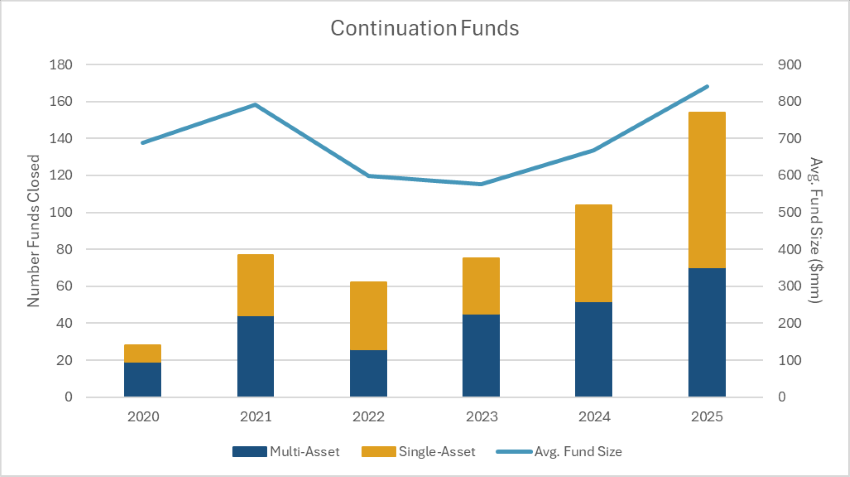
The private equity industry is grappling with a backlog of more than 13,300 portfolio companies, reinforcing the need for alternative liquidity solutions that can bridge the gap between value creation and exit execution.1 As highlighted in today’s Chart of the Week, continuation fund activity, measured by both transaction volume and deal size, has continued its upward trajectory, driven by a challenging deal-making environment.2 This growth has intensified recently amid heightened macroeconomic and geopolitical uncertainty, as well as growing concerns around the disruptive impact of artificial intelligence (AI) on traditional business models. These dynamics have contributed to persistent bid-ask spreads and tempered buyer risk appetite.
The continued expansion of continuation funds reflects more than sponsor preference; it is increasingly a function of necessity. With exit markets remaining challenged and initial public offering activity largely closed, sponsors face a growing mismatch between fund life cycles and asset readiness. Continuation funds may also be a byproduct of a higher-valuation private equity ecosystem.3 With acquisition multiples remaining elevated and higher financing costs, sponsors often require additional time to execute operational initiatives, drive earnings growth and fully realize value creation plans.
While demand remains strong for assets with durable growth and resilient earnings, sponsors have become reluctant to exit their highest-conviction companies at valuations that may not fully reflect the long-term value creation potential. This dynamic may help explain why activity in recent years suggests a clear shift in preference toward single-asset continuation vehicles rather than multi-asset portfolios, which generally offer cleaner underwriting and the ability to diligence specific company-level attributes such as durability of earnings, secular growth exposure and downside protection. Within that context, single-asset continuation funds provide limited partners (LPs) with targeted exposure to “trophy” assets and enable general partners (GPs) to extend ownership of their strongest performers.
The growth of continuation funds should also be viewed in the broader context of the institutionalization of secondaries markets. As LPs increasingly seek liquidity, shorter-duration exposure and more predictable deployment profiles, secondary strategies have moved from a niche allocation to a core portfolio component. Continuation vehicles represent one manifestation of this trend, sitting alongside LP-led secondaries and evergreen private market products as part of a broader evolution toward more flexible forms of private capital ownership.
Key Takeaway
Continuation funds have evolved from a tactical portfolio management tool into a structural feature of the private equity ecosystem. Persistent exit challenges, elevated hold periods, valuation uncertainty and growing LP demand for liquidity have created an environment where traditional fund timelines no longer align with asset ownership realities. As secondaries markets continue to mature and capital increasingly concentrates around high-quality assets, continuation vehicles are likely to play an increasingly important role in private equity capital formation, liquidity management and value realization.
Sources:
1,3PitchBook Data, Inc. – U.S. PE Breakdown; Q1 2026
2Preqin
This material is for informational use only. The views expressed are those of the author, and do not necessarily reflect the views of Penn Mutual Asset Management. This material is not intended to be relied upon as a forecast, research or investment advice, and it is not a recommendation, offer or solicitation to buy or sell any securities or to adopt any investment strategy.
Opinions and statements of financial market trends that are based on current market conditions constitute judgment of the author and are subject to change without notice. The information and opinions contained in this material are derived from sources deemed to be reliable but should not be assumed to be accurate or complete. Statements that reflect projections or expectations of future financial or economic performance of the markets may be considered forward-looking statements. Actual results may differ significantly. Any forecasts contained in this material are based on various estimates and assumptions, and there can be no assurance that such estimates or assumptions will prove accurate.
Investing involves risk, including possible loss of principal. Past performance is no guarantee of future results. All information referenced in preparation of this material has been obtained from sources believed to be reliable, but accuracy and completeness are not guaranteed. There is no representation or warranty as to the accuracy of the information and Penn Mutual Asset Management shall have no liability for decisions based upon such information.
High-Yield bonds are subject to greater fluctuations in value and risk of loss of income and principal. Investing in higher yielding, lower rated corporate bonds have a greater risk of price fluctuations and loss of principal and income than U.S. Treasury bonds and bills. Government securities offer a higher degree of safety and are guaranteed as to the timely payment of principal and interest if held to maturity.
All trademarks are the property of their respective owners. This material may not be reproduced in whole or in part in any form, or referred to in any other publication, without express written permission.