
Living the Dream? The New Economics of Homeownership
September 24, 2026
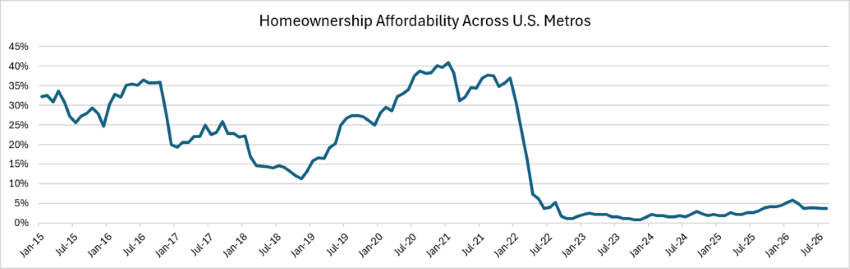
Homeownership has long been viewed as a cornerstone of the American Dream and a primary vehicle for wealth creation. The extended period of low interest rates following the global financial crisis helped make owning a home a reality for many American families. Rates on 30-year fixed-rate mortgages reached a floor around 2.7% in late 2020 and early 2021,1 marking an affordability peak for new homebuyers.
Today’s Chart of the Week examines one of the many challenges facing families — the affordability of homeownership. Since 2022, the share of U.S. metros where a new mortgage would consume less of a household’s income than renting has fallen sharply.2 Rapid home price appreciation, elevated mortgage rates and rising property tax and insurance costs have significantly increased the cost of ownership, leaving many families to choose between building equity and preserving financial flexibility. The affordability challenge extends beyond the expense line items. The gap between the income required to purchase a median-priced home and actual median household income has widened substantially since 2021.3 Today, a typical potential homebuyer needs almost 50% more yearly income than they earn for ownership costs to account for no more than 30% of the budget.4 To manage this reality, new homebuyers may need to cut back elsewhere or save a larger down payment, delaying entry into the housing market. The median age of first-time homebuyers now sits at 40 years old, up from 35 just three years ago.5,6
In response to these affordability pressures, both the public and private sectors have implemented measures intended to lower the barriers to homeownership. Many state and federal programs help ease the burden of owning real estate, especially for first-time homebuyers. The 21st Century ROAD to Housing Act, which became law in July, attempts to curb the proliferation of institutional ownership within the single-family housing market.7 However, the legislation’s near-term impact may be muted as many institutional operators have already shifted toward build-to-rent and renovate-to-rent strategies not covered by the bill. On the private side, 63% of homebuilders offered rate buydowns and similar incentives in August to help offset a 30-year mortgage rate hovering around 7%.8,9 Despite these efforts, housing market dynamics continue to constrain both prospective and existing homeowners. More than half of homeowners with mortgages today have an interest rate of 4% or less, creating a "golden handcuffs" effect that discourages moving, restricts housing inventory and compounds the barriers to homeownership.10
Key Takeaway
Prospective homebuyers face a housing market that looks very different from the one that existed just a few years ago. Affordability concerns may require households to save for larger down payments, adjust expectations or reconsider the timing of a purchase. Yet the demand for homeownership remains remarkably resilient, suggesting a delay rather than demise of the American Dream.
Sources:
1Freddie Mac – Mortgage Rates; as of 9/17/26
2Zillow Research – Housing Data; as of 9/17/26
3,4Federal Reserve Bank of Atlanta – Home Ownership Affordability Monitor; as of 9/17/26
5National Association of Realtors – First-Time Home Buyer Share Falls to Historic Low of 21%, Median Age Rises to 40; 11/4/25
6National Association of Realtors – First Time Homebuyers Are Older Than Ever Before: National Association of REALTORS® –Fox Business, Cavuto Coast to Coast; 12/4/24
7Holland & Knight – 21st Century ROAD to Housing Act: What Institutional Investors Need to Know; 8/25/26
8National Mortgage Professional – New-Home Mortgage Applications Fall For Fifth Straight Month; 9/15/26
9Mortgage News Daily – Today's Mortgage Rates; as of 9/17/26
10National Mortgage Professional – Shift In The Lock-In Era: Share Of Mortgages Above 6% Surpasses Those Below 3%; 1/21/26
This material is for informational use only. The views expressed are those of the author, and do not necessarily reflect the views of Penn Mutual Asset Management. This material is not intended to be relied upon as a forecast, research or investment advice, and it is not a recommendation, offer or solicitation to buy or sell any securities or to adopt any investment strategy.
Opinions and statements of financial market trends that are based on current market conditions constitute judgment of the author and are subject to change without notice. The information and opinions contained in this material are derived from sources deemed to be reliable but should not be assumed to be accurate or complete. Statements that reflect projections or expectations of future financial or economic performance of the markets may be considered forward-looking statements. Actual results may differ significantly. Any forecasts contained in this material are based on various estimates and assumptions, and there can be no assurance that such estimates or assumptions will prove accurate.
Investing involves risk, including possible loss of principal. Past performance is no guarantee of future results. All information referenced in preparation of this material has been obtained from sources believed to be reliable, but accuracy and completeness are not guaranteed. There is no representation or warranty as to the accuracy of the information and Penn Mutual Asset Management shall have no liability for decisions based upon such information.
High-Yield bonds are subject to greater fluctuations in value and risk of loss of income and principal. Investing in higher yielding, lower rated corporate bonds have a greater risk of price fluctuations and loss of principal and income than U.S. Treasury bonds and bills. Government securities offer a higher degree of safety and are guaranteed as to the timely payment of principal and interest if held to maturity.
All trademarks are the property of their respective owners. This material may not be reproduced in whole or in part in any form, or referred to in any other publication, without express written permission.